
When Your Child Asks “Why?” and You Don’t Know the Answer
“Why does the moon follow our car?” “Why do ants walk in a line?” “Why did that leaf turn red?”
Some questions arrive while we are making dinner or trying to get everyone into the car. Others come at the end of a long day, when there is not much energy left for an explanation. It is easy to assume that being a helpful parent means having the answer ready. But children do not need a walking encyclopedia. They need an adult who takes their wondering seriously.
The National Association for the Education of Young Children (NAEYC) encourages parents to value children’s questions and to say, when appropriate, “I don’t know, but we can find out together.” That response does more than buy time. It shows a child what learning looks like when the answer is not immediately available.
A question is not always a request for a lecture
A child asking about a bug may have noticed how it moves. A child asking why the sky is orange may want you to stop and look with them. Before reaching for a detailed explanation, it helps to find out what sparked the question: “What did you notice?” or “What made you wonder about that?”
Sometimes the child already has a theory. It may be imaginative, incomplete, or unexpectedly perceptive. Hearing it first tells you what they are trying to understand. It also keeps the conversation from becoming a quiz in which the adult delivers facts and the child is expected to remember them.
This is not an argument against accurate answers. If you know the answer, share it in language your child can use. Just remember that the question may be the beginning of a conversation, not a demand for a miniature science lesson.
The first answer can be a question

“What do you think is happening?” is useful when it comes from genuine interest, not as a test. If a preschooler asks why ants are moving across the sidewalk, you might watch them together and ask, “Where do you think they’re going?” If an older child notices that a wet patch dries faster in sunlight, you might compare it with a shaded patch.
The point is not to make a child guess correctly before you tell them the truth. The point is to let their observation lead. NAEYC’s guidance on early science suggests shifting from explaining everything to helping children investigate, compare, and talk about what they notice.
There are also moments when the best response is simply, “I’m not sure.” We can be honest without sounding defeated. “I haven’t thought about that before. Let’s look more closely” communicates that uncertainty is part of learning, not something to hide.
Make room for a small investigation

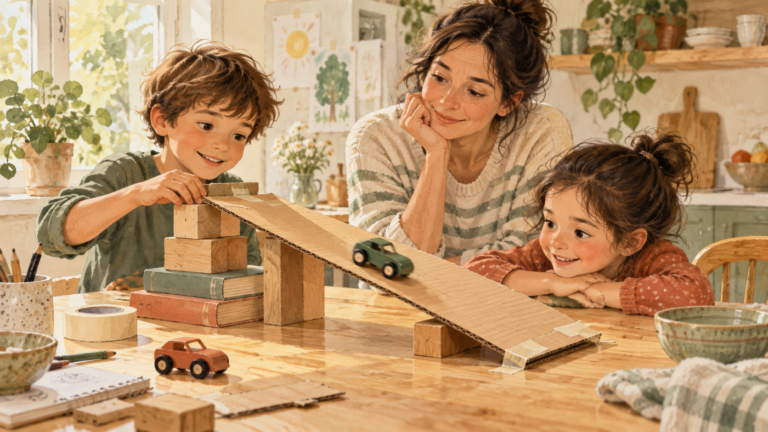
Not every question needs a project. Often a tiny test is enough. If a child asks whether a seed needs water to grow, you could plant two seeds in separate cups and observe what happens, while keeping other conditions as similar as you reasonably can. If the question is about which objects float, a bowl of water and a few safe household items may make the answer visible.
For a younger child, the investigation may be mostly noticing: “This one sank. That one stayed on top.” For an older child, you can go further: “What changed? What stayed the same? What should we try next?” If you discover that your first explanation was wrong, say so. Revising an idea is part of careful thinking.
A drawing or photo can help a child remember what they observed. NAEYC recommends simple records—pictures, drawings, or an adult writing down a child’s words—as ways to follow a question over time. A bean in a jar or a shadow on the wall can become more interesting when you return to it tomorrow.
Keep safety and common sense in the picture. Choose age-appropriate materials, supervise water and small objects, and leave unfamiliar plants, insects, or substances alone. Wonder does not require a complicated experiment.
When a source is needed, look together—but choose carefully
Some answers cannot be found at the kitchen table. A book from the library, a museum’s educational page, or a reputable science organization may help. You can say, “Let’s see who studies this,” and show your child how you decide whether a source is trustworthy. That is more valuable than presenting the first search result as unquestionable fact.
Try looking for one clear answer rather than opening ten tabs. Then bring the answer back to the child’s original observation: “We learned that ants can follow scent trails. What do you see them doing now?” The outside source supports the conversation; it does not replace the child’s attention.
If the question touches on health, safety, or a fear your child has, avoid experimenting or guessing. Give a simple, reassuring response, and seek an appropriate professional source when needed.
You can postpone an answer without dismissing the question
Real family life is not an uninterrupted learning session. If you are driving, handling a younger sibling, or trying to finish dinner, it is reasonable to say, “I want to think about that with you. Can we come back to it after we eat?” The important part is coming back when you can.
One practical habit is to keep a small “wonder list” on the fridge or in a notebook. Write down the question in the child’s own words. Some questions will lose their urgency. Others will lead to a library book, a walk outside, or a short conversation days later. The list is not homework; it is a way to show that their thoughts did not vanish when the moment became busy.
Curiosity belongs to ordinary days
We sometimes imagine STEM learning as a special kit, a carefully planned activity, or an answer that sounds impressive. Yet the heart of it is much quieter: noticing, asking, trying, comparing, and changing our minds when we learn more. A child can practice those habits while watching a puddle disappear or wondering why one block tower keeps falling.
You will not know every answer. Neither will your child. That is not a failure in the conversation. It may be the most honest place to begin: “I don’t know yet. What do you notice?”