
Teaching Kids Gratitude Without Asking Them to Hide Hard Feelings
A child is upset because a long-awaited plan has changed. An adult, trying to help, says, “But you have so much to be thankful for.” The words may be true. They may also land like a request to stop talking about what hurts.
Many Christian parents want their children to grow in gratitude. We want them to notice gifts, appreciate people, and thank God for daily provision. But there is a difference between inviting gratitude and asking a child to prove it on command. A child can be thankful for a loving family and still be disappointed that a friend could not come over. A parent can be grateful and tired at the same time.
If we want gratitude to become part of our children’s lives, it has to be roomy enough for honesty.
Gratitude and disappointment can belong in the same sentence
Sometimes we use thankfulness to hurry a child out of an uncomfortable feeling: “At least you still have other toys.” “At least the rain stopped.” “You should be grateful.” None of these sentences necessarily addresses the experience the child is trying to share.
The Bible makes room for a more honest conversation. Psalm 13 begins with a painful question and moves toward trust. 1 Thessalonians 5:18 calls believers to give thanks in all circumstances. Reading these passages together, I do not hear a command to call every hard thing good. I hear permission to bring a real experience before God while looking for what can still be received with thanks.
That distinction matters for children. “I am sad we couldn’t go, and I am glad we can try again next week” is more truthful than “I should not be sad because I have other things.” Gratitude does not need to cancel disappointment. It can sit beside it.
Listen before you look for the lesson

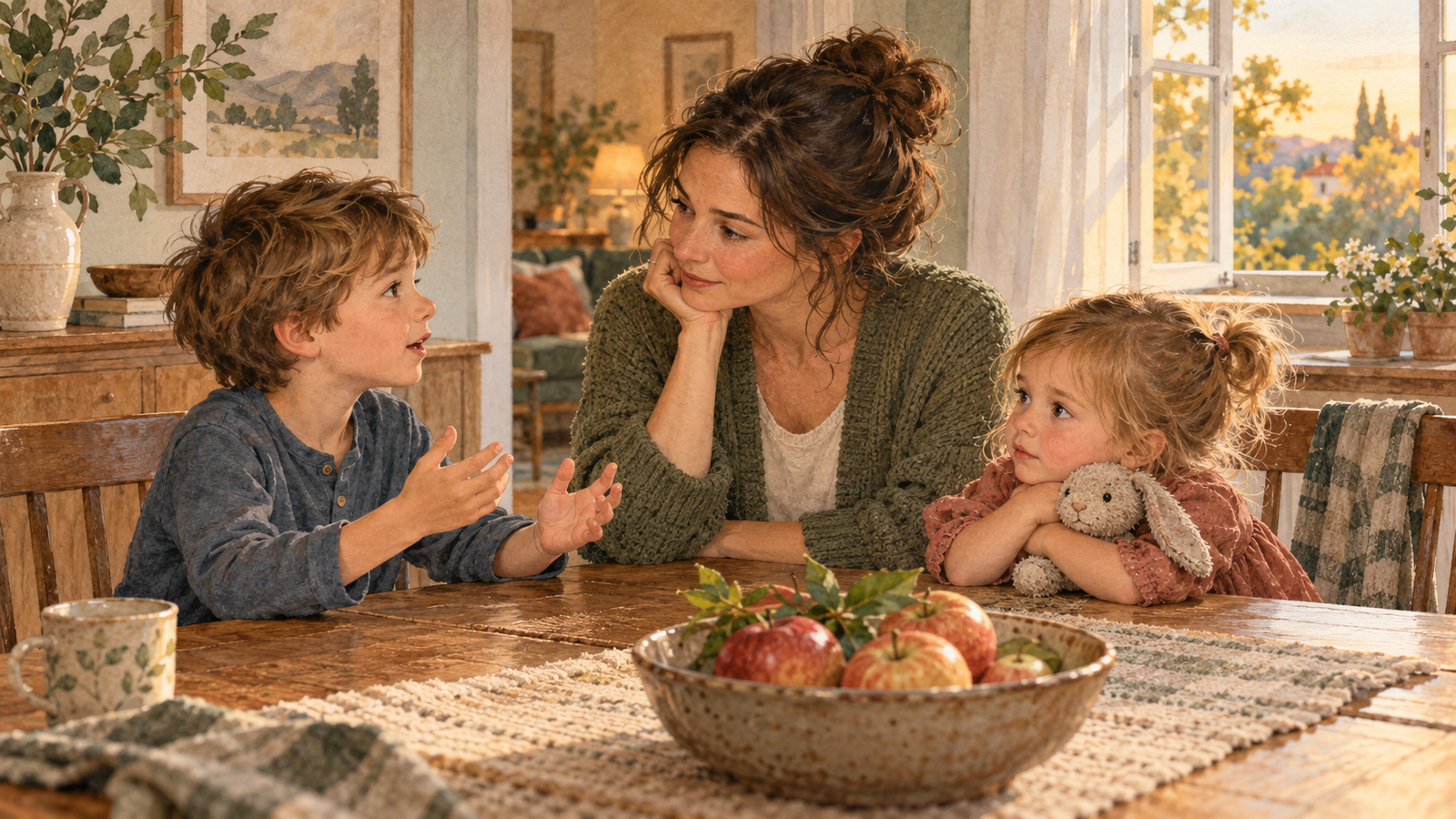
When a child is upset, the first helpful response is often not a teaching point. It is attention. “You were really looking forward to that.” “It makes sense that you’re disappointed.” “Would you like to tell me what you had hoped would happen?”
This does not mean agreeing with every demand or changing every limit. It means letting the child know their feelings have been heard. The American Academy of Pediatrics recommends acknowledging, naming, and validating children’s emotions while still helping them manage their behavior. A child who feels understood may be more able to talk about what comes next; forcing a “thank you” in the middle of tears usually skips that first step.
If you want to bring faith into the moment, the prayer can be honest too: “God, we’re disappointed. Help us with this day.” There is no need to add a happy ending before the child is ready.
Make gratitude specific and ordinary
Children learn a great deal from what adults notice out loud. That may be more useful than asking, “What are you grateful for?” every night and waiting for the right answer.
A parent might say, “I appreciated that your brother helped carry the bags.” Or, “I’m thankful we had time to sit together.” Or simply, “That person was kind to us.” These are small, particular observations. They show gratitude as attention to people and moments, not a performance of cheerfulness.
The AAP’s guidance on nurturing gratitude likewise encourages parents to model thankfulness and talk about it in ordinary family life—not only at Thanksgiving. For Christian families, that everyday approach also fits the picture in Deuteronomy 6:6–7: faith is spoken about while people live together, not only during formal instruction.
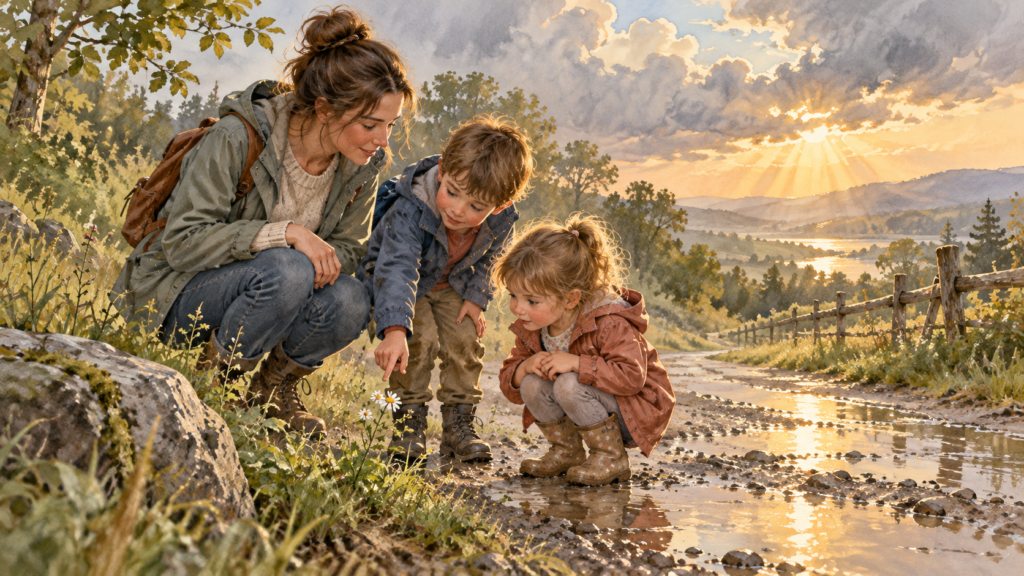
There is no need to manufacture a “gratitude moment” out of every walk or meal. Sometimes a child notices a flower after the rain, or someone remembers a kindness from that morning. A parent can make room for it without demanding that the moment become a lesson.
Invite a response; don’t require one
An invitation might sound like, “Was there one good thing in your day?” If the child says no, you can leave it there. Perhaps they need rest or help first. Perhaps tomorrow’s answer will come easily.
The question can also change with the child’s age. A preschooler may point to something they enjoyed or name a person they missed. A school-age child may describe a friend’s kindness—and still tell you about a difficult part of school. Older children may prefer a conversation in the car or while doing something side by side. The point is not collecting three blessings from every person at the table. It is making it safe to notice and speak truthfully.
Here is one example of a gentler exchange, not a script that must be followed:
Child: “Today was awful. I didn’t get to play with my friend.”
Parent: “That was disappointing. Do you want to tell me about it?”
Later: “I was glad we could sit together when you got home.”
The parent has not corrected the child’s account of the day. They have offered one true thing alongside it.
Let gratitude become action, not just words
Thankfulness can grow through noticing what other people do and responding in kind. A child may draw a note for someone who helped them, thank a caregiver for a ride, or join the family in preparing food for a neighbor. These gestures should fit the relationship and the child’s willingness; they are not a way to make a disappointed child prove they are good.
The AAP includes sincere thanks, helping others, and parental example among ways families can practice gratitude. The most meaningful version is often concrete: we received kindness; now we can notice it and, when possible, offer kindness too.
When gratitude language starts to sound like pressure
It helps to pause when we hear ourselves say, “Other children have it worse,” or “After everything we’ve done for you, you should be grateful.” These phrases may come from adult fatigue. But comparison does not erase a child’s problem, and gratitude cannot be demanded as repayment for care.
Parents are allowed to have limits and to ask for respectful behavior. We can say, “You may be disappointed, and you still need to speak kindly.” That is different from saying, “You may not feel disappointed.” A family can teach both courtesy and emotional honesty.
If a child is facing persistent sadness, distress, or a change in behavior that concerns you, do not treat gratitude practice as a substitute for support. Ask the child’s pediatrician or a qualified mental-health professional for guidance.
A faith that has room for the whole day
I hope children learn to thank God for good things. I also hope they know they can come to Him on days when they cannot think of a single happy sentence. A faith lived at home is not made stronger by pretending every day was wonderful.
Perhaps the most lasting lesson is a quiet one: we can name what was hard, receive the care we need, and notice goodness when we genuinely see it. Honest gratitude is not less spiritual because it arrives slowly. It may be the kind our children can carry into real life.
References and further reading
- Psalm 13 (NIV)
- 1 Thessalonians 5:18 (NIV)
- Deuteronomy 6:6–7 (NIV)
- American Academy of Pediatrics: Beyond Thanks—5 Ways to Nurture Gratitude in Children
- American Academy of Pediatrics: Healthy Mental & Emotional Development—4 Key Building Blocks
This article offers general parenting reflection, not mental-health treatment or individualized advice.