
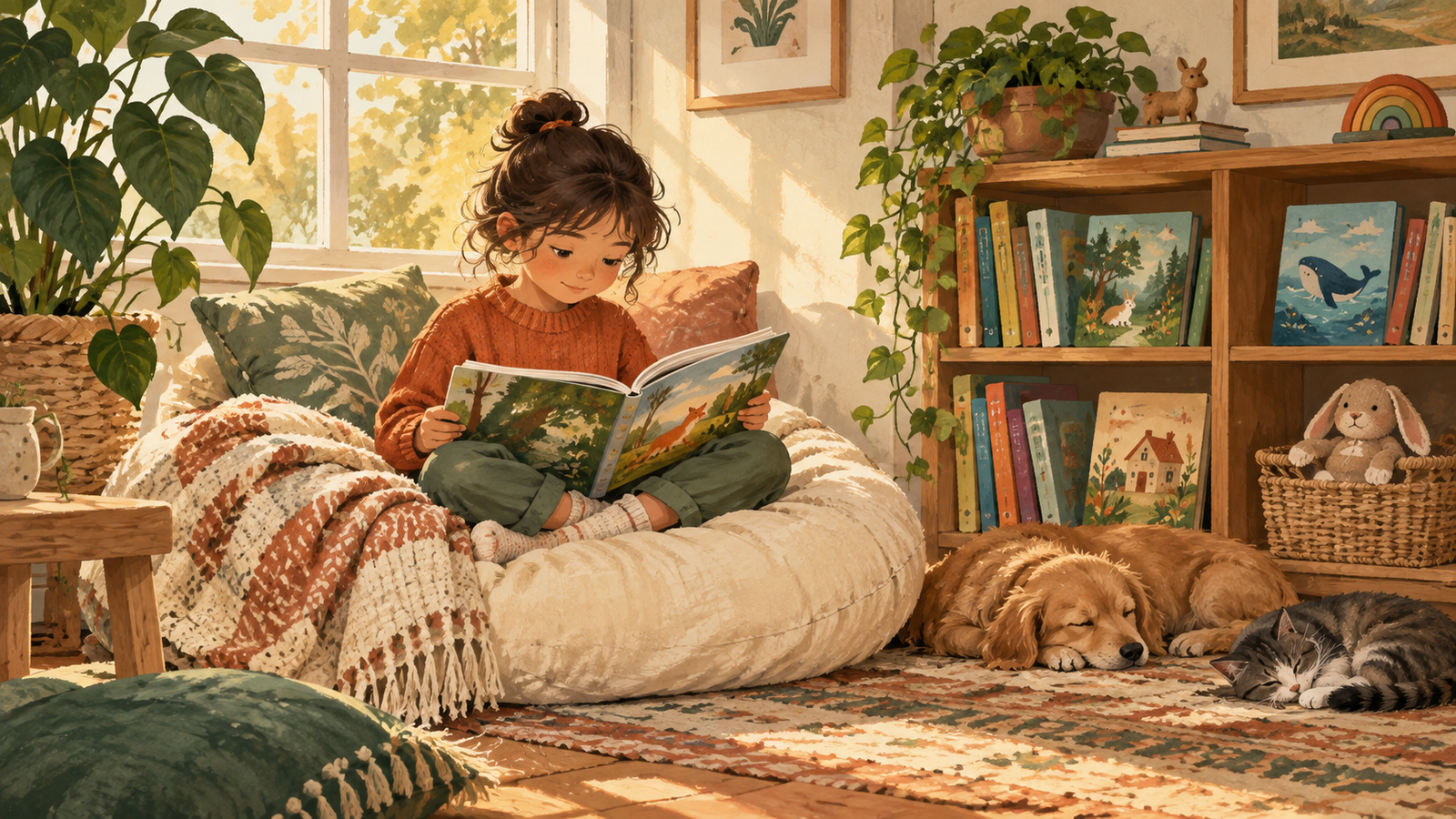
How to Raise a Reader Without Turning Books Into Homework
Many parents want their children to love reading.
They buy books, visit the library, create cozy reading corners, ask about school assignments, and encourage quiet time. They do these things because they understand that reading matters.
But somewhere along the way, books can start to feel like another task.
Children may be asked how many pages they read, whether they understood every detail, what lesson they learned, or whether they chose a book at the “right” level. Reading can become associated with performance, correction, and progress instead of comfort, curiosity, and pleasure.
The good news is that raising a reader does not require turning home into another classroom.
In fact, one of the most valuable things parents can do is protect the idea that books can simply be enjoyable.
School Teaches Reading Skills. Home Can Protect the Pleasure of Reading.
Children need to learn how to decode words, understand texts, build vocabulary, and develop reading fluency. School plays an essential role in that work.
Home can offer something different.
At home, books can be places to rest, laugh, imagine, revisit favorite characters, ask strange questions, and explore personal interests. A child can read a comic book, a joke book, a graphic novel, a book about sharks, a fantasy story, or the same picture book every night for two weeks.
Not every reading experience needs to be educational in the obvious sense.
When children learn that books are associated only with assignments, they may avoid them. When they learn that books can belong to their own interests and routines, reading has a better chance of becoming part of who they are.
A Child Does Not Need to Love Every Book
Adults often remember one special book from childhood. That can make us eager to hand the same title to our children and hope for the same response.
Sometimes it works. Often, it does not.
Children have their own tastes, moods, attention spans, and reading histories. A child who does not enjoy a classic chapter book may still love mysteries, comics, animal facts, poetry, fantasy, humor, sports stories, manga, cookbooks, or books about machines.
Their preferences do not need to match yours to be valid.
The American Academy of Pediatrics encourages parents to let children choose books, follow their interests, and reread favorites. That advice matters because ownership is part of motivation.
A child is more likely to return to reading when they feel they have some control over what reading looks like.
Re-Reading Is Not a Waste of Time
Many children want the same book again and again.
Adults may feel tempted to say, “We already read that one,” or “Let’s pick something new.” But repetition can be comforting, enjoyable, and useful.
When a story is familiar, children can notice details they missed before. They can join in with repeated phrases, anticipate what will happen, study the illustrations, and feel confident in a story they know well.
For younger children, repetition can support language development. For older children, rereading can be a way to return to a character, a world, or a feeling that mattered to them.
There is no prize for finishing the most books.
A child who reads one beloved book many times may be building a stronger relationship with reading than a child who rushes through a long list of titles without enjoying any of them.
Reading Aloud Still Matters After Children Can Read Independently
Many families stop reading aloud once a child begins reading on their own.
But reading aloud does not need to end at that point.
Older children can still enjoy being read to, especially with books that may be above their independent reading level or stories that are simply more fun to share. Reading together can become a quiet family ritual: before bed, during a long car ride, on a rainy afternoon, or while everyone relaxes after dinner.
Jim Trelease’s long-running book The Read-Aloud Handbook, now continued with educator Cyndi Giorgis, has helped generations of parents and teachers think about reading aloud as a way to build a lasting relationship with books.
The value is not in performing a perfect reading voice.
It is in creating a shared experience.
You can pause to laugh, wonder what may happen next, admire an illustration, or let the child interrupt with a completely unrelated story. That is not ruining the reading experience. For many children, it is part of what makes it meaningful.

Not Every Book Needs a Lesson
Questions can be helpful, but too many questions can make reading feel like a quiz.
Instead of always asking, “What was the main idea?” or “What did you learn?” try leaving space for a child’s own reaction.
You might say:
- “That ending surprised me.”
- “I wonder what you think about that character.”
- “This picture has so much happening in it.”
- “I liked that part because it was funny.”
- “Would you want to visit that place?”
These comments invite conversation without demanding the correct answer.
Sometimes the child may have nothing to say. That is fine too.
A book does not need to lead to a craft, worksheet, vocabulary exercise, or moral lesson in order to have value. A story can simply be a story.
Reading Can Look Different for Different Children
Some children sit still with books for long stretches. Others listen while building blocks, drawing, pacing, or playing quietly nearby.
Some children prefer print books. Others enjoy audiobooks, read-along books, comics, or graphic novels. Some children go through phases where they read constantly, then barely pick up a book for a while.
There is no single image of what a reader looks like.
The American Academy of Pediatrics notes that reading together can support children’s language, learning, and connection, even when a child does not follow every word or sit perfectly still.
The important question is not, “Is my child reading exactly the way I expected?”
It is, “What helps my child feel comfortable enough to return to stories?”
A Reading Routine Does Not Need to Be Long
Parents often think they need to establish a long, formal reading routine. In reality, consistency matters more than duration.
Five calm minutes can be enough.
A short book after breakfast. A chapter before bed. A magazine in the waiting room. A library visit on Saturday. A story read aloud while a child plays with a quiet toy.
These small routines tell children that books belong in everyday life.
Reading does not need to compete with every other activity. It can become part of the rhythm of the home.
Make Books Easy to Reach
A reading space does not need special furniture or a large collection.
A small basket of books near the couch, a few titles by the bed, a shelf at child height, or regular library visits can be enough. The goal is not to display books beautifully. The goal is to make them easy to pick up.
Consider keeping a mix of books available:
- Familiar favorites
- Books connected to your child’s current interests
- Funny books
- Books with pictures or visual storytelling
- Nonfiction books
- Poetry, songs, or rhymes
- Books that invite conversation
Libraries are especially valuable because they allow children to explore freely without every book needing to become a permanent purchase.
Be Careful With Rewards and Reading Logs
Rewards can be useful in some situations, especially when a child needs encouragement with a school goal. But when rewards become the main reason to read, they can accidentally send the message that reading is something children need to be paid to do.
The same is true of reading logs when they become stressful.
A child may begin choosing only short books to finish faster. They may hide reading that does not “count.” They may become focused on the number of minutes rather than the pleasure of the story.
If your family uses goals or logs, try to keep the tone gentle. Let them be a tool, not a judgment.
The longer-term aim is for a child to see reading as something they can choose for themselves.
When a Child Says They Do Not Like Reading
A child who says they hate reading is not necessarily saying they hate stories.
They may dislike the kind of books they have been offered. They may be tired from school. They may find reading difficult or frustrating. They may prefer to listen, draw, build, move, or talk.
Start with curiosity instead of pressure.
Ask what they enjoy watching, playing, or talking about. Look for books connected to those interests. Try audiobooks together. Read something funny. Let them choose a book that seems easy. Visit the library without the expectation that they must leave with a “serious” title.
If reading continues to feel consistently difficult or distressing, it can be helpful to talk with the child’s teacher, librarian, pediatrician, or another qualified professional. The goal is not to label a child quickly. It is to understand what kind of support may help.
Reading Is Also About Connection
One of the simplest reasons to read with children is that it creates shared time.
A book can open a conversation that might not happen otherwise. It can help children find words for emotions, questions, fears, and hopes. It can give families a quiet routine in the middle of a busy day.
You do not need to be an expert reader, teacher, or storyteller.
You only need to make room for books without turning them into another performance.
A child who sees reading as comforting, interesting, funny, and personal is already building a foundation that matters.
Final Thoughts
Raising a reader is not about filling a bookshelf, finishing a reading challenge, or finding the perfect book.
It is about helping children understand that stories are available to them.
They can return to old favorites. They can abandon books that are not working. They can choose silly books, serious books, easy books, strange books, and books about whatever matters to them right now.
When reading is allowed to remain joyful, children have more space to make it their own.
Sources and Further Reading
- American Academy of Pediatrics: Tips to Help Your Child Enjoy Reading Aloud
- American Academy of Pediatrics: Sharing Books With Children
- Trelease, Jim, and Cyndi Giorgis. Jim Trelease’s Read-Aloud Handbook.
- Penguin Random House: Jim Trelease’s Read-Aloud Handbook




One Comment