How Kids Learn Math in Everyday Life — Beyond Worksheets
Math is often introduced to children as something that happens at a desk: a worksheet, a timed quiz, a page of problems to finish before moving on.
But long before children meet formal equations, they are already making sense of quantity, space, patterns, comparison, and change. They notice that one snack bowl has more crackers than another. They work out whether a tower is tall enough to reach the couch. They hear a timer beep and understand that something has ended. They divide the last two strawberries between siblings and recognize, very clearly, when the split does not feel fair.
These are not “pre-math” moments that only matter before real learning begins. They are real mathematical thinking.
The goal at home is not to turn every errand, meal, or play session into a lesson. It is to notice the ideas already present in a child’s ordinary day and give them a little language, curiosity, and room to think.
Math is more than getting the right answer
When adults think about helping a child with math, counting is usually the first thing that comes to mind. Counting matters, of course. But a strong early foundation includes much more:
- comparing amounts: more, less, equal, enough;
- recognizing and extending patterns;
- understanding shape, position, and space;
- measuring and estimating;
- sorting, grouping, and organizing information;
- explaining how a solution was reached.
The U.S. Department of Education’s What Works Clearinghouse recommends that early math include not only number and operations, but also geometry, patterns, measurement, and data analysis. It also emphasizes helping children describe their world mathematically and integrating math into the day, rather than treating it as a separate subject that appears only at one designated time. Teaching Math to Young Children
That distinction matters. A child can recite numbers to twenty and still be unsure whether five objects are more than seven. Another child may not know every numeral yet, but may be very capable of building a repeating pattern, comparing two piles, or explaining which container will hold more water.
Math is not just a list of answers. It is a way of making sense of the world.
The everyday moments that already contain math
A home does not need special equipment to become a place where mathematical thinking is welcome. Ordinary routines are full of natural invitations.
In the kitchen: quantity, measurement, and change
Cooking is full of visible math, but it does not need to become a formal recipe lesson.
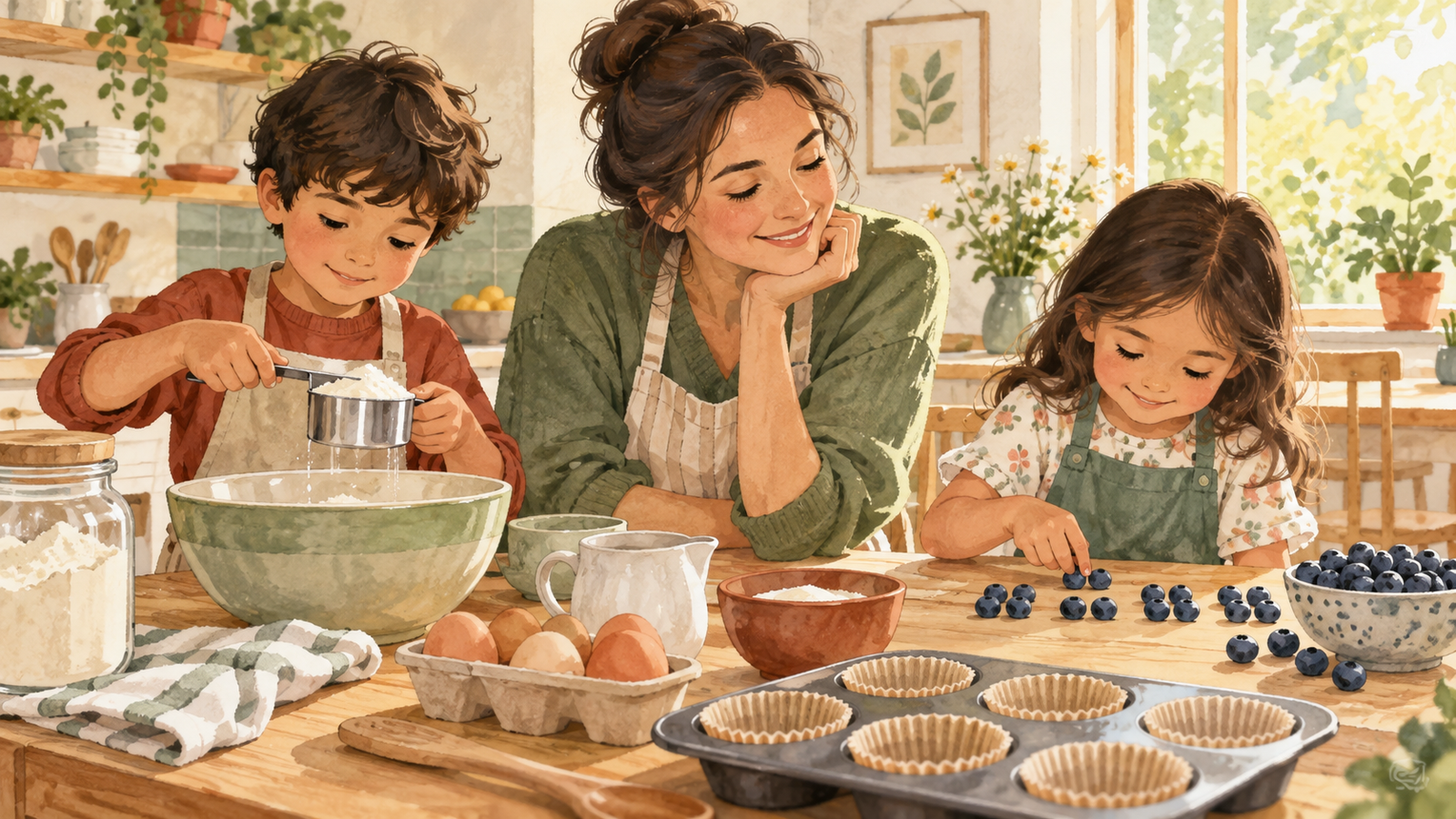
A preschooler might help count eggs, compare spoon sizes, notice that a full measuring cup holds more than a half-full one, or decide whether there are enough plates for everyone at the table. An older child can double a simple recipe, estimate how many apples are needed for lunches, or compare prices and package sizes at the store.
The most useful part is often the conversation, not the calculation.
Instead of saying, “What is the answer?” try:
- “Do you think this bowl will hold all of the berries?”
- “We need one for each person. How can we check?”
- “Which scoop is bigger? How do you know?”
- “The recipe needs two cups, and we only have a one-cup measure. What could we do?”
These questions invite children to predict, test, revise, and explain. That is richer than simply being told what to count.
During play: patterns, space, and problem-solving
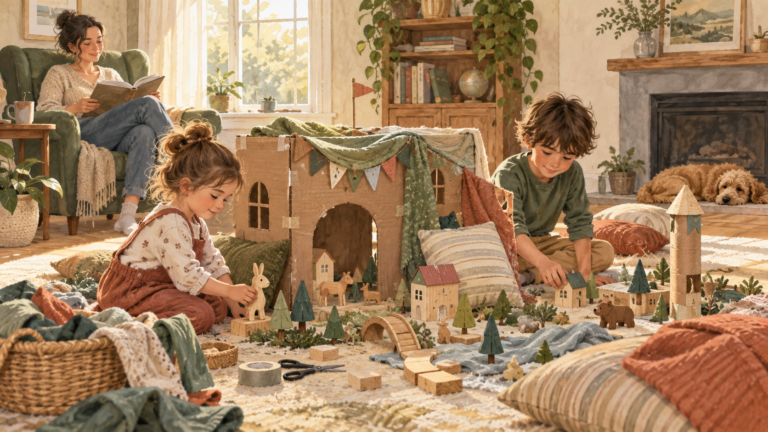
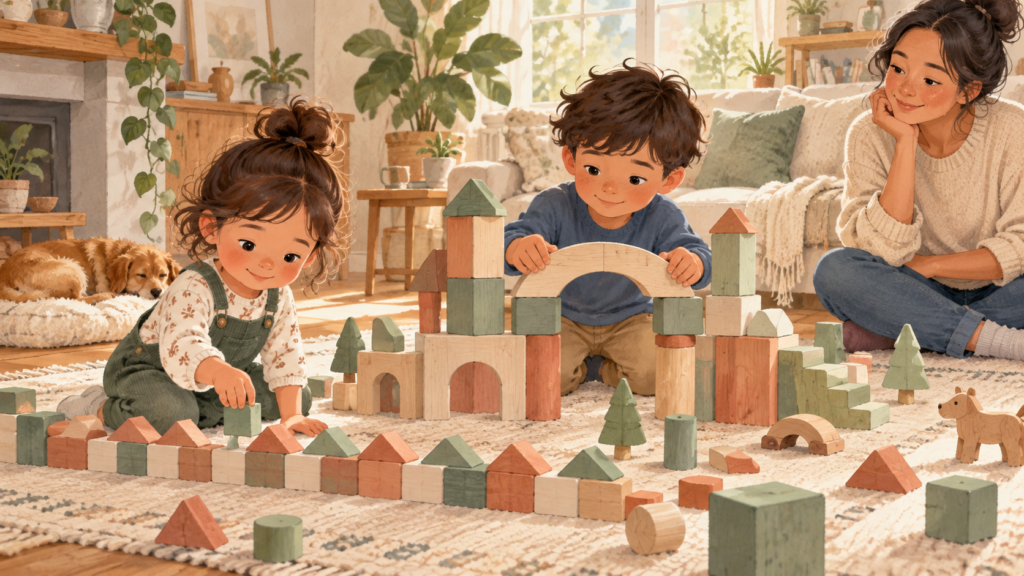
Blocks, toy cars, magnetic tiles, dolls, stuffed animals, and even couch cushions can become tools for mathematical thinking because children are already solving real problems with them.
A child arranging blocks by size is comparing. A child making a red-blue-red-blue bracelet is building a pattern. A child trying to fit every toy animal into a small basket is exploring space and capacity. A child creating a road for toy cars is thinking about direction, distance, and shape.
You do not need to interrupt play to teach. Often, a quiet observation is enough:
“I noticed you used the biggest blocks at the bottom. What made you choose that?”
Or:
“Your road turns three times. Where does it end?”
The point is not to turn play into a performance. It is to show children that their own ideas are worth noticing.
Language helps children hold onto an idea
Children often understand more than they can yet explain. Giving them useful words helps them connect an experience to a concept.
Words such as more, fewer, same, equal, heavier, lighter, longer, shorter, beside, between, before, and after are not decorations around math. They are part of how children learn to describe relationships.
The What Works Clearinghouse’s family resources encourage adults to use math language, ask open-ended questions, and embed math in everyday activities. It also cautions that the goal is a positive learning environment, not frustration or math anxiety. Teaching Math to Young Children for Families and Caregivers
This means we can be specific without being intense.
At the grocery store, “Can you count?” may feel like a test. “We need three bananas. Do you think this bunch has enough?” feels like a real problem with a real purpose.
At bedtime, “What comes next in the routine?” supports sequence and memory. While setting the table, “We have four forks out. How many people can eat?” makes quantity meaningful.
Small language changes make math feel like a tool for life, not a subject children are either “good at” or “bad at.”
Estimation deserves more respect
Many adults rush to correct an estimate. If a child says there are one hundred books on the shelf when there are actually fourteen, it can be tempting to say, “No, that is much too many.”
But estimation is not about being exact. It is about developing a sense of what quantities mean.
A more helpful response might be:
“One hundred would be a lot. Let’s look more closely. Do you think there are more than ten? More than twenty?”
This keeps the child’s original thought alive and invites a better comparison. Over time, children begin to calibrate their guesses through experience.
Try estimation in ordinary moments:
- How many steps will it take to reach the mailbox?
- How many cups of water will fill this container?
- How long will it take to tidy the blocks?
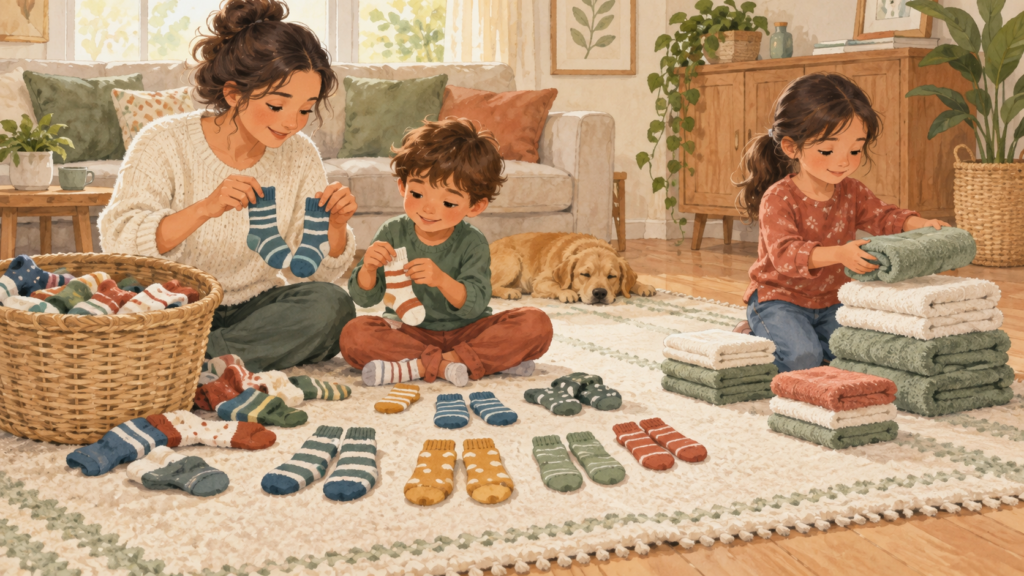
- How many socks are in the laundry basket?
- Will all of these books fit on this shelf?
The answer is less important than the process of making a prediction and checking it.
Board games teach more than winning
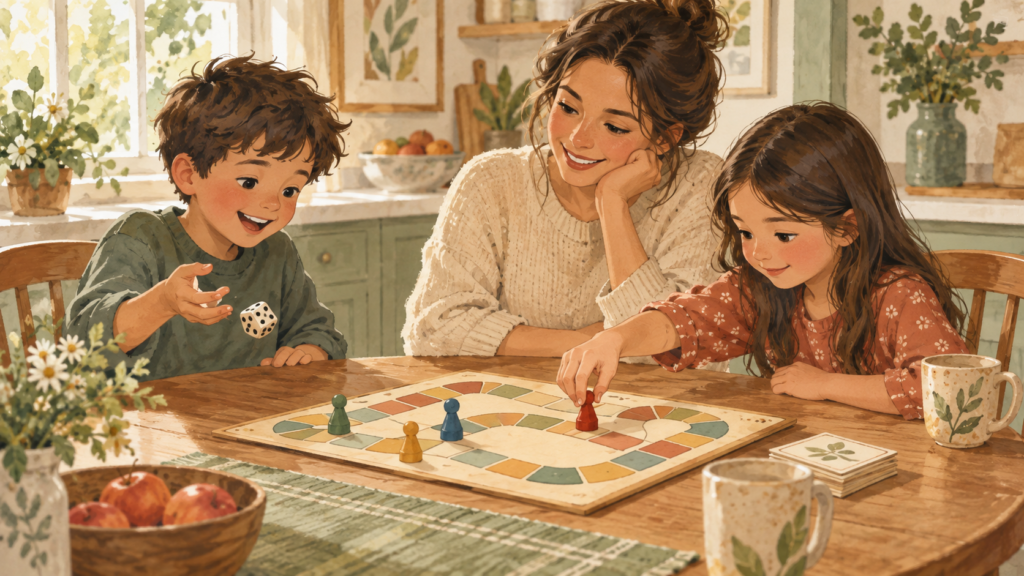
Simple board games can offer repeated, low-pressure practice with counting, turn-taking, comparing, planning, and recovering from disappointment.
A child who moves a game piece four spaces is connecting a spoken number to a physical action. A child who watches another player move ahead is comparing positions. A child deciding whether to use a special card now or later is beginning to think strategically.
The research guide from the What Works Clearinghouse recommends integrating math across the day and using games to practice concepts, while noting that a game works best as part of a thoughtful, broader approach — not as a magical shortcut. Teaching Math to Young Children: Practice Guide
Choose games that match the child rather than the age printed on a box. For a young child, that might mean rolling one die and counting spaces slowly. For an older child, it could mean keeping score, comparing points, or adjusting a rule together.
If a game becomes stressful, simplify it. The relationship with math matters more than playing by every rule.
A child does not need to be fast to be mathematical
Speed is often mistaken for understanding. A child who answers quickly may have strong recall, but a child who pauses, draws a picture, uses fingers, builds a model, or talks through a problem may be doing equally important work.
At home, it helps to praise the thinking rather than the speed.
Instead of:
“You got it so fast!”
Try:
“I like how you checked your answer.”
Or:
“You tried one way, then changed your plan when it did not work.”
This kind of response tells children that math is something they can reason through. It is especially important for children who have started to believe that they are “not math people.”
Executive-function skills — including planning, focusing attention, switching strategies, and managing information — develop over time through supportive experiences. Those skills are closely connected to the persistence children need when a problem does not yield an immediate answer. Center on the Developing Child at Harvard University
A pause is not a failure. Sometimes it is the beginning of real understanding.
What to do when a child says, “I hate math”
First, resist the urge to persuade them with a speech about why math is important. A child who says they hate math is often saying something more specific:
- “I feel embarrassed when I do not know the answer.”
- “I am tired of being corrected.”
- “This feels too hard.”
- “I do not see what this has to do with me.”
- “I think everyone else understands it faster.”
Start with curiosity instead.
You might say, “That sounds frustrating. Which part feels hardest right now?” Then listen before trying to solve it.
At home, choose one small, non-threatening way to reconnect math to something real: splitting a pizza, measuring a bedroom wall for a poster, planning the timing for cookies, or comparing the distance of two walking routes.
If schoolwork is genuinely difficult, it is also appropriate to ask the teacher what concept is being taught and what strategies are already being used in class. Support is most effective when home and school are not sending conflicting messages.
A few questions are enough
Parents do not need to narrate every mathematical idea in a child’s day. That would make ordinary life exhausting for everyone.
A better approach is to notice one opportunity and ask one good question.
- “How could we make this fair?”
- “What do you notice?”
- “Which one holds more?”
- “What do you think will happen if…?”
- “Is there another way to do it?”
- “How can we check?”
Then leave room for the answer.
Sometimes the child will answer immediately. Sometimes they will shrug. Sometimes they will return to the idea later while they play. All of those responses are normal.
Math belongs in a life, not just on a worksheet
Worksheets can have a place, especially when a child enjoys them or needs practice with a specific school skill. But they are only one small format.
The deeper goal is for children to see that mathematical thinking is useful, flexible, and available to them. It helps them bake, build, share, organize, navigate, notice, plan, and solve problems that matter to them.
When adults make room for questions instead of rushing toward correct answers, math becomes less about proving ability and more about understanding the world.
That is a foundation worth building — one ordinary moment at a time.
Sources and further reading
- U.S. Department of Education, Institute of Education Sciences: Teaching Math to Young Children
- Institute of Education Sciences: Teaching Math to Young Children for Families and Caregivers
- Center on the Developing Child at Harvard University: A Guide to Executive Function