
What Makes a STEM Activity Worth Doing? Curiosity Over Perfect Experiments
There is a particular kind of pressure attached to children’s STEM activities.
It often arrives disguised as inspiration: a bright social-media video of a rainbow foam eruption, a perfectly engineered cardboard marble run, a child in a spotless kitchen announcing a conclusion with the confidence of a television scientist.
These projects can be lovely. But they can also leave parents with the impression that science at home requires a kit, a script, a dramatic result, and a child who is immediately interested.
It does not.
A meaningful STEM experience may look much quieter: a child wondering why a block tower keeps falling, comparing which jacket dries first after the rain, trying three different ways to make a paper airplane fly farther, or watching what happens when ice melts in a sunny spot.
The value is not in whether the result is impressive enough to photograph. It is in whether the child gets to notice, wonder, test an idea, and revise it.
That is the heart of STEM.
STEM is not a project category
STEM stands for science, technology, engineering, and mathematics. But for young children, those subjects are rarely separate in the way adults remember them from school.
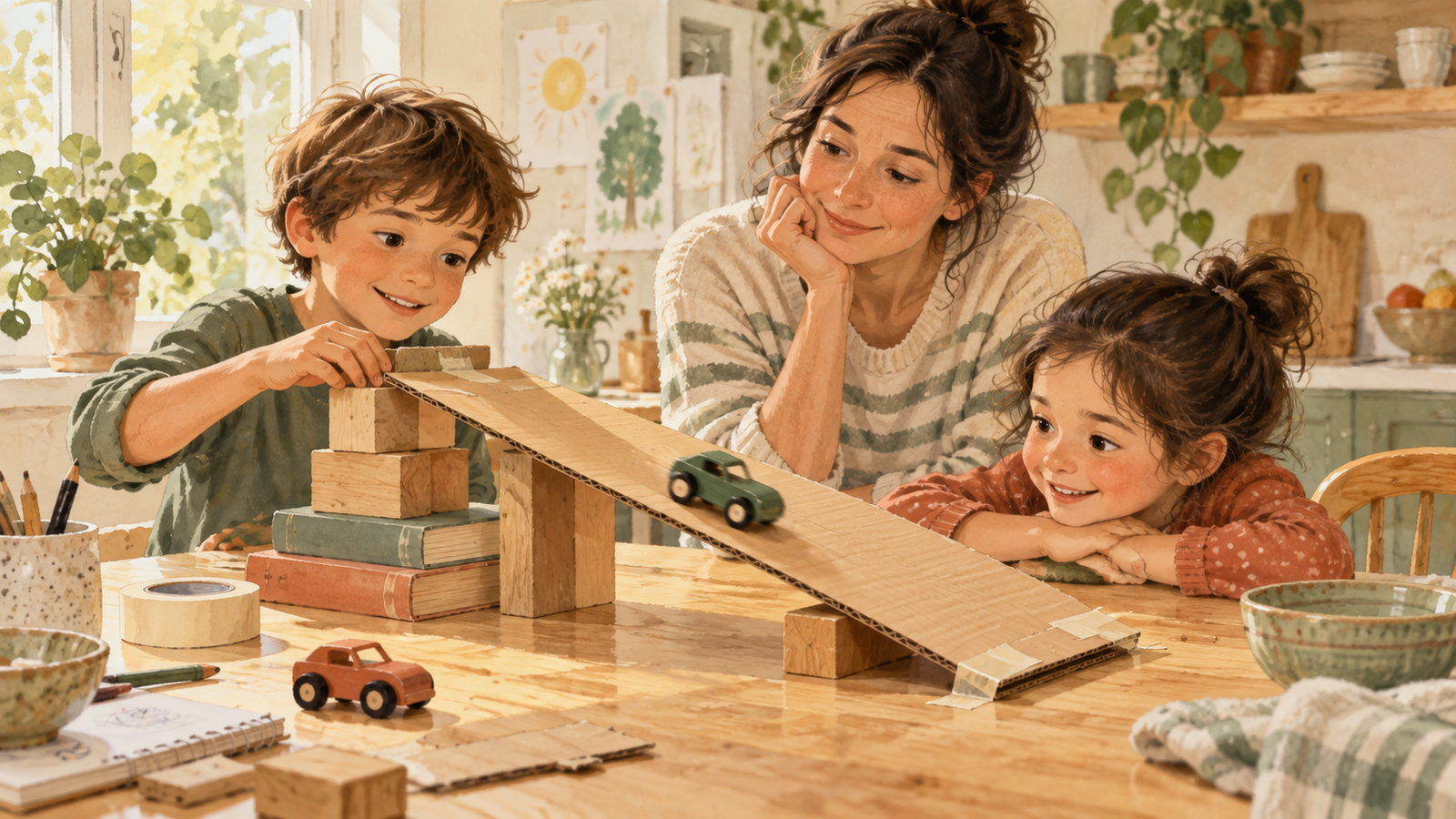
A child building a ramp for toy cars is exploring force and motion. A child deciding which blocks will hold up a bridge is experimenting with balance and structure. A child sorting leaves by shape is observing, categorizing, and comparing. A child trying to make a flashlight shine through different materials is investigating light.
None of these moments need a worksheet attached to count as learning.
The National Association for the Education of Young Children describes early STEM as emerging through play: children plan, experiment, negotiate, test ideas, and revise. The materials can be simple; what matters is time, open-ended possibilities, thoughtful questions, and the chance to explain their thinking. STEM Starts with Play
This is an important shift for parents. We do not need to “deliver a STEM activity.” We can create conditions in which a child’s natural investigation is taken seriously.
A good activity begins with a real question
The strongest STEM experiences are usually built around questions children genuinely care about.
Not:
“Today we are going to learn about buoyancy.”
But perhaps:
“Why did this little boat sink when we added one more stone?”
Not:
“Let’s study shadows.”
But:
“Why is your shadow so long right now?”
The question does not need to be sophisticated. In fact, simple questions are often the best ones because children can see, touch, test, and revisit them.
Here are a few everyday questions that can open the door:
- What makes some objects roll farther than others?
- Which paper will make the strongest bridge?
- Why does the puddle disappear?
- Can we build a tower that is taller than the couch cushion?
- What happens if we change only one part of our design?
- Which materials keep an ice cube cold for longer?
- How can we make this toy car move more slowly?
The answer is not the only goal. The process of wondering, predicting, testing, and talking about what happened is where the learning lives.
Head Start describes this inquiry cycle simply: ask questions, make observations, predict possible outcomes, try something, and discuss what actually happened. Children begin this kind of inquiry very early; adults can support it by giving them time to explore before stepping in with an answer. Engaging Interactions: Using the Scientific Method
The result does not need to “work”
This may be the most useful rule for doing STEM at home: a failed design is not a failed activity.
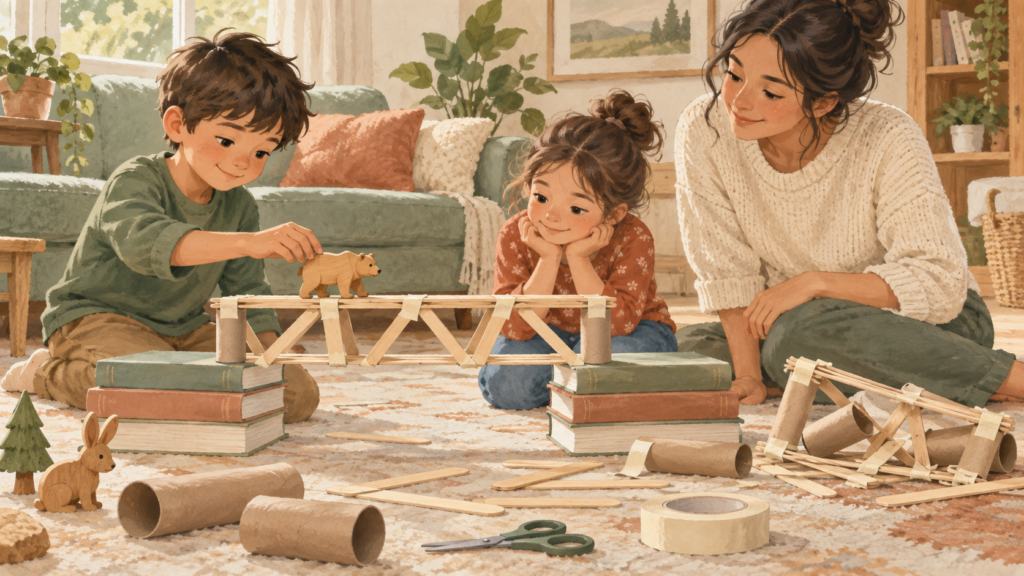
If a paper bridge collapses, the child has information. If the seed does not sprout, there is something to investigate. If the baking-soda experiment barely fizzes, there may be a reason — or an opportunity to wonder what could change next time.
Adults sometimes rush to rescue the outcome because we want children to feel successful. But taking over can quietly teach the opposite lesson: that a good scientist gets it right quickly.
Real scientific and engineering work involves uncertainty, trial, observation, and revision. Children deserve to experience that version of learning too.
When something does not go as expected, try saying:
- “That was not what we predicted. What do you notice?”
- “What do you think made that happen?”
- “Would you like to change one thing and try again?”
- “What part of your plan worked?”
- “What should we keep the same next time?”
These questions protect the child’s ownership of the idea. They also make space for persistence without turning persistence into pressure.
Materials do not need to be special
There is nothing wrong with a science kit, but it is not a requirement for thoughtful STEM learning.
Some of the most flexible materials are already in a typical home:
- cardboard tubes and boxes;
- masking tape;
- cups, spoons, and containers;
- paper, foil, and scrap fabric;
- blocks and magnetic tiles;
- toy cars and balls;
- ice, water, and kitchen-safe containers;
- leaves, sticks, stones, and seed pods collected outdoors;
- flashlights used with an adult.
The National Science Teaching Association notes that everyday life is rich with science experiences — from a sink full of dishes to a rain puddle — when adults prepare an environment for exploration, focus children’s observations, and make time to talk about what they saw. Science at Home
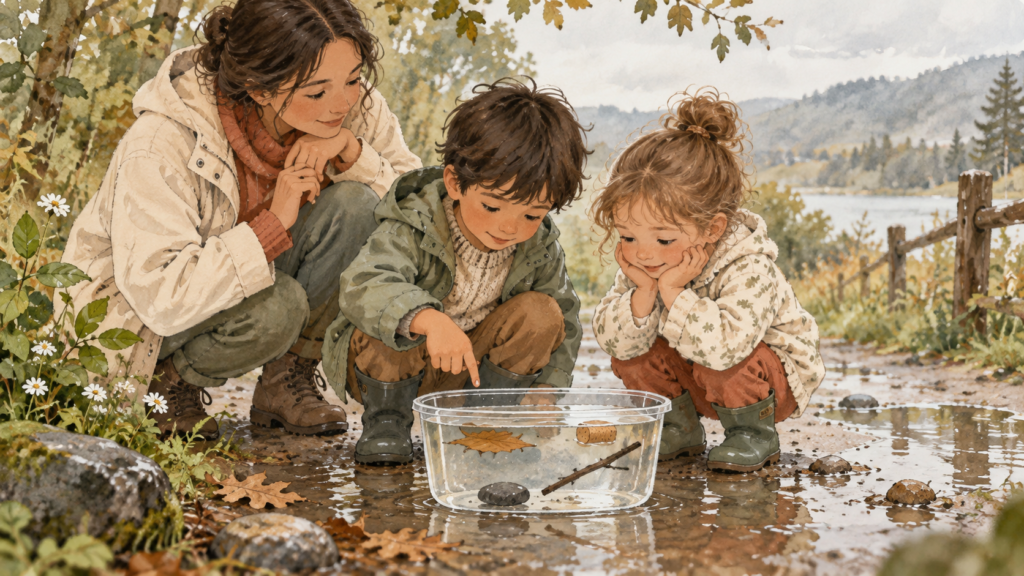
The material is only the starting point. A cardboard box becomes engineering when a child tries to make it hold weight. Water becomes science when a child compares what floats, sinks, pours, freezes, or changes shape. A walk becomes biology when a child notices that some leaves have smooth edges and others have points.
The adult’s job is not to explain everything
Children do need adults in their scientific lives. But the most helpful role is not always “expert with the answer.”
Often, it is observer, listener, and keeper of the materials.
Instead of explaining why something happens immediately, try to find out what the child thinks first.
“What is your idea?”
“How could we test that?”
“What did you see?”
“Did it happen the same way this time?”
“What would you like to try next?”
These are not trick questions. They are invitations to think.
The NSTA’s early-childhood science guidance emphasizes that adults play an essential role when they help children focus observations and have time to talk about what they did and saw. Science at Home
That last part — time to talk — is easy to overlook. A child who has spent fifteen minutes making a ramp may need another five minutes simply to explain what changed between attempt one and attempt four. That explanation is part of the activity, not an extra.
The best STEM questions are open enough to allow different answers
A scripted experiment often has one expected result. Inquiry has room for variation.
For example, instead of asking a child to copy a specific paper airplane, invite them to make two versions and decide which one travels farther. Instead of building the same tower shown in a picture, ask how they might make a structure stable enough to hold a small stuffed animal. Instead of telling them which objects will float, let them choose a few safe objects and sort their predictions before testing.
Open-ended problems support more than scientific knowledge. They encourage planning, language, collaboration, creativity, and flexible thinking.
NAEYC describes inquiry-based STEAM experiences as opportunities for children to build understanding, vocabulary, critical thinking, problem-solving, communication, and reflection through hands-on questions and high-quality conversation. Breaking Down STEAM for Young Children
This does not mean the adult must invent brilliant questions. A single genuine question is often enough.
A few simple experiences worth revisiting
The most meaningful home investigations are often the ones that can be returned to over several days.
Build a better ramp
Use cardboard, books, a baking sheet, or a firm piece of wood as a ramp, with a toy car or ball.
Invite your child to change just one element at a time:
- the height;
- the surface;
- the object rolling down;
- the position at the start.
Rather than trying to teach physics vocabulary immediately, notice the changes together. Which version went farther? Which slowed down? What made the difference?
Test a small boat
Offer a shallow tub or bowl of water, foil, recycled plastic lids, corks, or other safe household items.
A child can design a boat and test how many small, dry objects it can carry before sinking. If it sinks, they can reshape it and try again.
This is a beautiful example of engineering because the child has a problem, a material, a test, and an opportunity to revise.
Always stay with young children around water, even when the container is shallow.
Follow a shadow
On a sunny day, choose one familiar object outside and trace or photograph its shadow at different times.
Children may notice that the shadow changes length and direction. You do not need to offer a complete explanation in one session. Let the observation lead.
“What do you think changed?” is a wonderful place to begin.
Make an ice investigation
Place equal-sized ice cubes in different safe containers or locations: a metal bowl, a towel, a sunny windowsill, a shaded spot, or an insulated cup.
Ask what the child predicts before you begin. Check at intervals. Record with drawings, photos, or simple marks if they are interested.
The point is not to create a laboratory report. It is to see that predictions can be tested.

Safety is part of real science
A meaningful STEM activity should also feel manageable and safe.
For young children, choose materials that are age-appropriate and avoid small pieces that may present a choking risk. Use only adult supervision with water, heat, glass, tools, batteries, magnets, chemicals, balloons, or anything that could be swallowed, broken, or misused.
You do not need dramatic reactions, flames, or complicated household chemistry to create wonder. In fact, simple, repeatable explorations are usually more valuable because children can be active participants rather than spectators.
A safe activity says: “You can explore this.” That sense of agency matters.
Protect the child’s relationship with uncertainty
Children are naturally drawn to figuring things out. We can accidentally weaken that instinct when we correct every wrong guess, hurry to finish the project, or praise only a polished result.
Try praising observations and strategies instead:
- “You noticed the heavier blocks needed a wider base.”
- “You changed one thing at a time.”
- “You kept trying after the first design fell.”
- “You had a different idea from mine. Let’s see what happens.”
- “You found a way to test your question.”
This kind of language teaches children that they are capable of thinking, not just following instructions.
It also gives them a more honest picture of STEM: not a collection of impressive experiments, but a way of meeting the world with attention and possibility.
Curiosity is the outcome worth protecting
A child does not need to memorize the scientific method, build a robot, or complete a Pinterest-worthy experiment to be learning STEM.
They need opportunities to notice something interesting, make a guess, try an idea, and discover that changing course is allowed.
The most successful activity may end with a collapsed bridge, a wet sleeve, a confusing result, and a child who says, “Can we try that again tomorrow?”
That is not a messy version of learning.
It is learning.
Sources and further reading
- National Association for the Education of Young Children: STEM Starts with Play
- National Association for the Education of Young Children: Breaking Down STEAM for Young Children
- National Science Teaching Association: Science at Home
- Head Start: Engaging Interactions: Using the Scientific Method