Why Toy Storage Keeps Failing Families — and What Actually Makes It Easier
Toy storage is often presented as a shopping problem.
We are shown matching baskets, labeled bins, elaborate shelving systems, and picture-perfect playrooms. The message is subtle but powerful: if your home feels overwhelmed by toys, you simply have not found the right containers yet.
But most families do not have a storage problem.
They have a systems problem.
A system fails when it asks more from an exhausted parent or a young child than either can realistically give at the end of an ordinary day. It fails when every toy has a complicated home, when the child cannot reach the shelf, when cleanup requires sorting ten tiny categories, or when there are simply more toys in the room than the space can comfortably hold.
The answer is usually not another bin.
It is a simpler relationship with what stays out, what gets put away, and what your child can manage independently.
Why Beautiful Toy Storage Often Stops Working
A storage system may look wonderful the day it is organized.
Then life happens.
A child dumps out several bins looking for one missing piece. A sibling joins in. Someone brings home a party favor. A grandparent arrives with a gift. A parent is cooking dinner while trying to answer a question about a lost dinosaur.
By evening, the room is full again.
The problem is not that the family failed to follow the system. The system was designed for a calm photograph, not a real Tuesday.
A useful toy-storage system needs to work when:
- Your child is tired
- You are tired
- There are two children playing at once
- Cleanup needs to happen quickly
- A child wants to start playing without adult help
- A toy does not belong to one obvious category
- New toys enter the home
If a system only works when an adult is directing it, it is not really a child-friendly system. It is an adult chore disguised as organization.
The First Shift: Store Less in the Active Play Space
The most useful storage change is often not organizational at all.
It is reducing the number of toys that are available at one time.
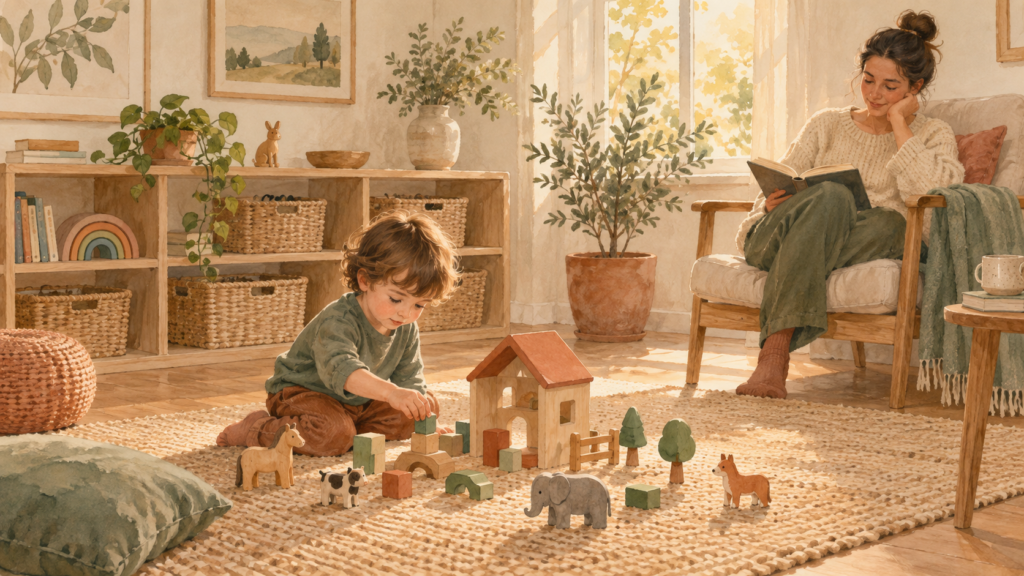
This does not mean children need a nearly empty room. It means that the active play area should contain a manageable selection: toys that fit their interests, their current abilities, and the kind of play your family wants to encourage.
A small study published in Infant Behavior and Development compared toddlers playing with four toys and with sixteen toys. In the lower-toy setting, children played with individual toys for longer and used them in a greater variety of ways. The study was small, with 36 toddlers, so it should not become a rigid rule for every home. But it offers a helpful reminder: more options do not always lead to deeper play. Read the study summary on PubMed.
A child who has fewer toys in view may be more likely to build, imagine, repeat, combine, and return to an activity.
And a parent who sees fewer toys on the floor may be more likely to feel calm enough to join the play.
Think in Three Levels, Not One Huge Collection
A practical home usually needs three different places for toys.
1. Everyday toys
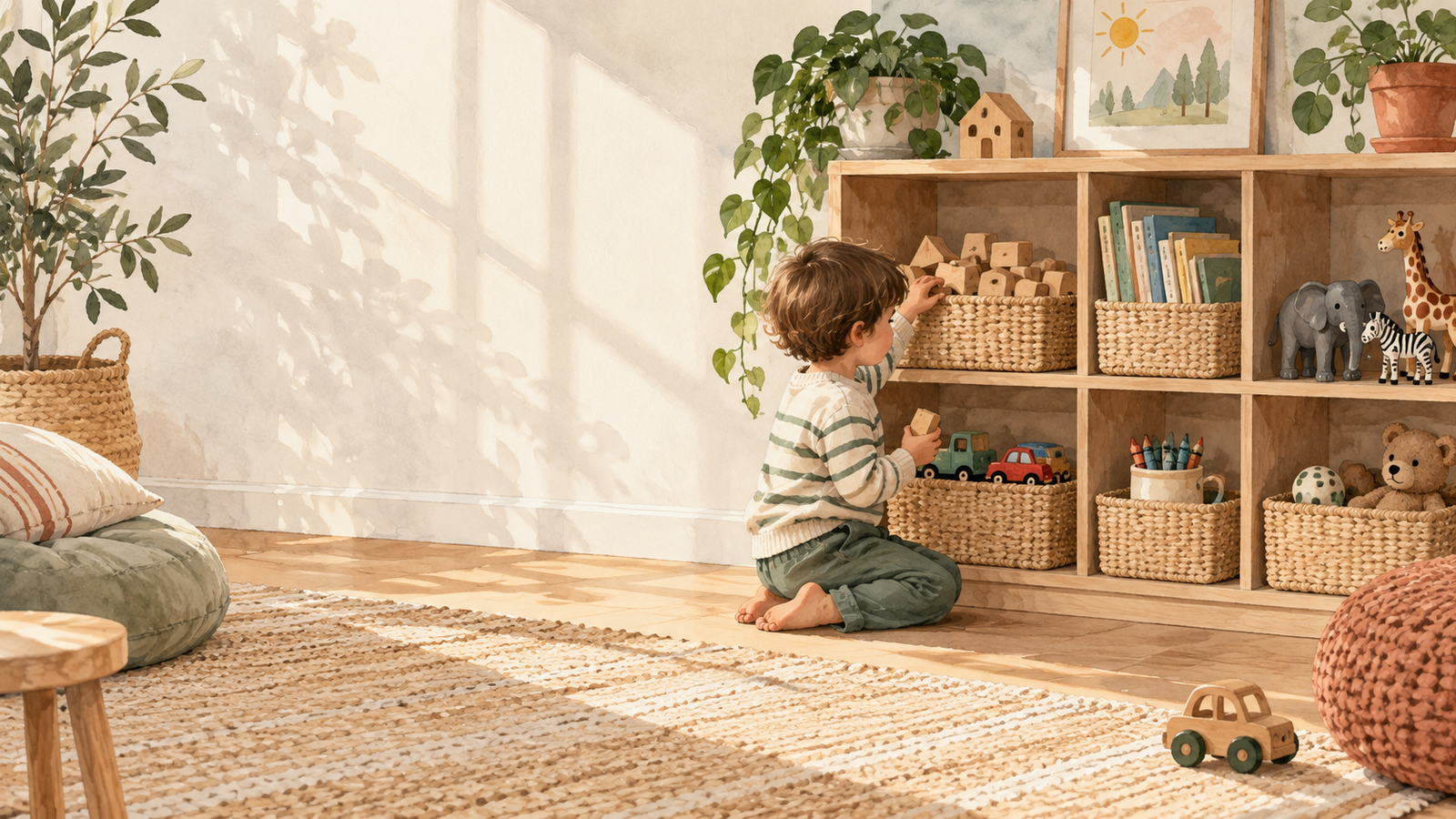
These are the toys your child can see and reach without help.
Keep this group small. It might include:
- A set of blocks
- A few vehicles or animal figures
- One pretend-play option
- Puzzles
- Books
- Crayons and paper
- One simple sensory or building activity
These are the toys that deserve the most accessible storage.
2. Rotation toys
These are still good toys, but they are not needed every day.
Store them in a closet, a high shelf, an under-bed container, or a clearly labeled bin that adults can access. Every few weeks—or when your child seems bored—bring out a few items and put away a few that have been heavily used.
Toy rotation does not need to be complicated. You do not need a schedule, a spreadsheet, or a perfectly balanced selection of categories.
You can simply notice what your child has not touched recently and make a small change.
ZERO TO THREE also suggests toy rotation as one way to keep a play environment fresh and supports independent play with a caregiver nearby. Their at-home activity guide is a helpful reference.
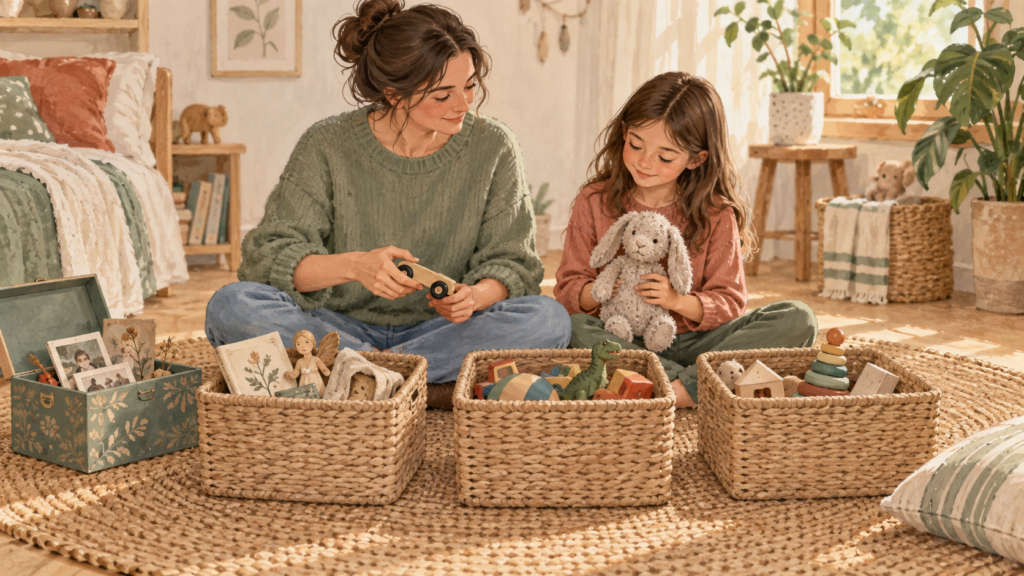
3. Keepsakes, projects, and “not right now” toys
This category is important because not every toy needs to be available for play.
Some items are sentimental. Some are too advanced. Some are for a younger sibling. Some are gifts your child is not ready to release. Some are craft projects waiting to be finished.
Give these toys a separate home.
A memory box, one labeled keepsake bin, or one seasonal storage container protects them without asking the active play space to carry everything.
The Second Shift: Make Cleanup Easier Than Leaving Everything Out
This is the rule that changes the most.
A child’s cleanup system should be easier than the mess.
If putting away blocks requires finding a tiny labeled compartment, opening a stiff lid, sorting by color, and placing each piece exactly right, the system is too complicated.
For young children, use broad categories:
- Blocks
- Cars
- Animals
- Dress-up
- Art supplies
- Puzzles
- Building toys
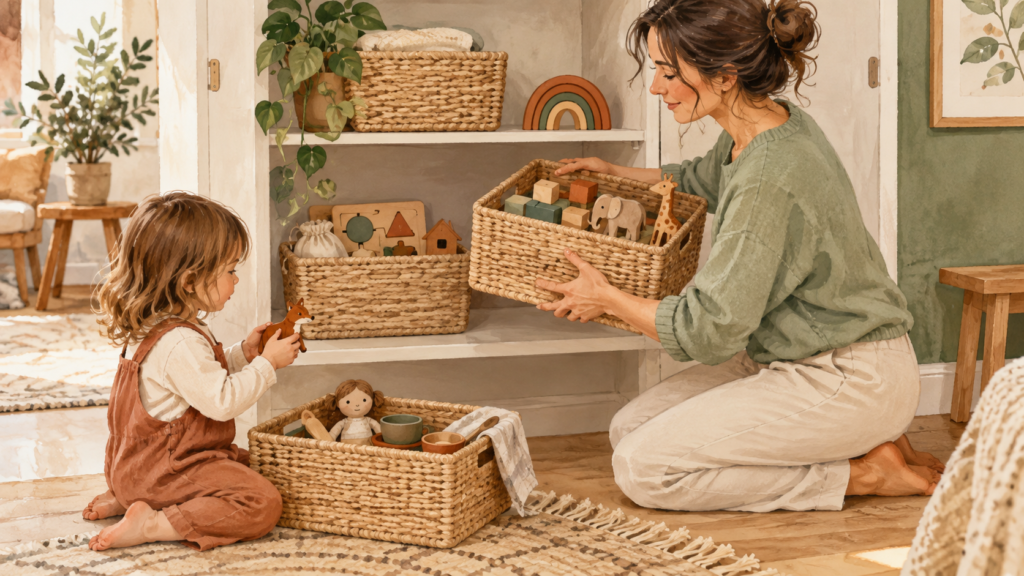
One wide, open basket for each category is often more useful than several small, carefully labeled containers.
The question is not, “Where does every individual item go?”
The question is, “Can this item get home in ten seconds?”
If the answer is yes, children have a much better chance of participating.
For toddlers, picture labels can help. Take a photo of the toys that belong in a basket, print it, and tape it to the front. A child who cannot read can still match toys to the picture.
Older children may prefer words, color labels, or simply knowing that each shelf has a purpose.
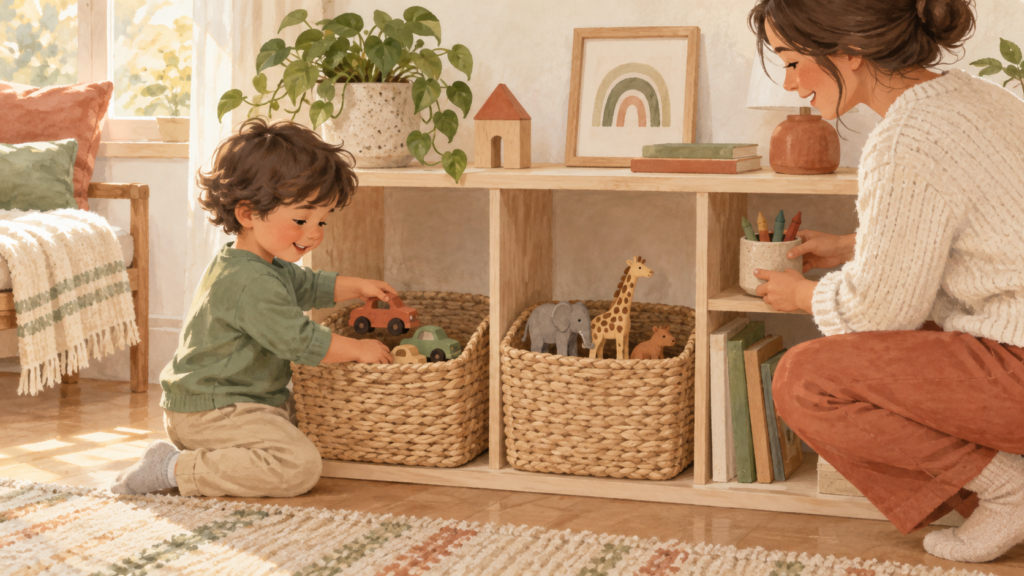
Put Storage at Your Child’s Level
Children cannot maintain a system they cannot physically use.
If the bins are too heavy, the shelves are too high, the lids are difficult to remove, or every useful material is out of reach, adults will become the gatekeepers of play and cleanup.
Early-childhood educators often focus on accessible materials because the physical environment affects children’s independence. The National Association for the Education of Young Children notes that materials within reach can support children’s ability to move, choose, and participate more independently. Read NAEYC’s discussion of accessible environments here.
At home, this can be very simple:
- Use low shelves for everyday toys.
- Choose open baskets over heavy lidded containers.
- Keep one category per basket.
- Place the most-used toys in the easiest-to-reach places.
- Move fragile, complicated, or adult-led materials higher up.
- Leave some clear floor space for play.
The goal is not to make children responsible for every household task. The goal is to make it possible for them to take part.
Stop Organizing Toys by the Way Adults Think
Adults often organize by type.
Cars with cars. Figures with figures. Craft pieces by color. Building toys by brand. Tiny accessories in individual compartments.
Children often organize by play.
A child may use a dinosaur, a wooden block, a scarf, and a small car in the same story. They do not necessarily see those things as separate categories. They see them as part of one world.
This does not mean storage should be chaotic. It means the categories should be broad enough to support the way children actually play.
Try organizing by invitation instead of product type:
- Build: blocks, magnetic tiles, wooden planks
- Imagine: dolls, animals, scarves, pretend food
- Move: balls, stepping stones, jump ropes
- Create: paper, crayons, stickers, washable paint
- Read and rest: books, soft floor cushion, small blanket stored outside the sleep space for older children’s daytime reading
This approach keeps the room simpler and reminds adults that toys do not need to be used in only one prescribed way.
A Cleanup Routine Is More Useful Than a Cleanup Lecture
Children are more likely to help clean up when cleanup is predictable.
A routine gives the task a beginning, middle, and end. It is not a punishment for playing. It is simply what happens before dinner, before bedtime, or before a new activity begins.
ZERO TO THREE explains that routines can help young children anticipate what comes next and can reduce power struggles. Their guide on routines offers examples of turning cleanup into a familiar transition.
Try one simple phrase every day:
- “It is time for the cars to park.”
- “Let’s help the animals go back to their basket.”
- “We can choose one more book after the blocks are home.”
- “You put away the puzzle pieces; I’ll put away the crayons.”
For younger children, start together. Do not expect them to restore an entire room alone.
For older children, make the expectation clear and limited: “Before we start the next activity, the building toys need to go back in their basket.”
The smaller and more consistent the routine, the more likely it is to last.
What to Do With Toys Your Child Will Not Let Go Of
Decluttering toys can become emotional quickly.
A child may want to keep a broken toy, a gift they do not use, or every tiny object from a party bag. That does not mean you need to keep everything, but it does mean the conversation matters.
Instead of asking, “Can we get rid of this?” try:
- “Do you still play with this, or is it something you want to remember?”
- “Would you like to keep this in your special memory box?”
- “Which three toys should stay out this week?”
- “Could another child enjoy this one now?”
- “Is this missing pieces or no longer working?”
Give children some real choices, but do not turn every object into a long negotiation.
For very young children, quietly remove broken, unsafe, or clearly outgrown toys. For older children, include them in the process but keep the decision focused and kind.
A home does not need to hold every object a child has ever owned to honor their childhood.
A One-Hour Reset for an Overwhelming Playroom
If the room feels impossible, do not begin by buying containers.
Start with one hour and four piles:
- Keep out now
- Store for rotation
- Keep as a memory or for a sibling
- Recycle, donate, or discard
Begin with visible broken items, incomplete games, dried-out markers, packaging, and toys no one has touched in a long time.
Then choose a small amount to remain in the active play area.
Do not aim for perfect. Aim for usable.
When the hour is over, stop. You can make another small decision next week.
The goal is not to create a room that never becomes messy. Children live and play in that room. It should become messy sometimes.
The goal is to create a room that can return to calm without requiring an entire afternoon.
A System That Works Is a Form of Care
Toy storage can seem like a small domestic issue. But it affects daily life.
It affects whether children can find what they want to play with. It affects whether they can join cleanup. It affects how often adults feel irritated by the room. It affects whether play feels inviting or overwhelming.
A good system does not make a home look like a store.
It makes the home easier to live in.
Keep fewer toys out. Use broad categories. Make storage reachable. Build one small cleanup routine. Let the system support your family instead of giving your family another standard to meet.
That is what makes toy storage work.
Sources and Further Reading
- Dauch, Imwalle, Ocasio, and Metz: The Influence of the Number of Toys in the Environment on Toddlers’ Play
- ZERO TO THREE: At-Home Activity Guide
- ZERO TO THREE: Creating Routines for Love and Learning
- NAEYC: A Sense of Place in the Early Childhood Classroom
- HealthyChildren.org: Young Children Learn a Lot When They Play