
A Homework Space Does Not Need to Be Perfect to Help Kids Focus
There is a particular kind of pressure that appears when children start bringing schoolwork home.
Suddenly, parents feel they need a dedicated desk, a perfectly organized bedroom, matching stationery, a wall calendar, a printer, and a quiet room with a door that closes.
But most families do not live in homes designed around homework.
They live in homes where the dining table is also used for meals, crafts, conversations, bills, and sometimes laundry. Siblings share bedrooms. Parents work from home. The kitchen is noisy at exactly the time schoolwork needs to happen. Some children want help nearby; others want space.
A helpful study space is not a Pinterest project.
It is simply a place that makes it easier for a child to begin, continue, and finish a small piece of work.
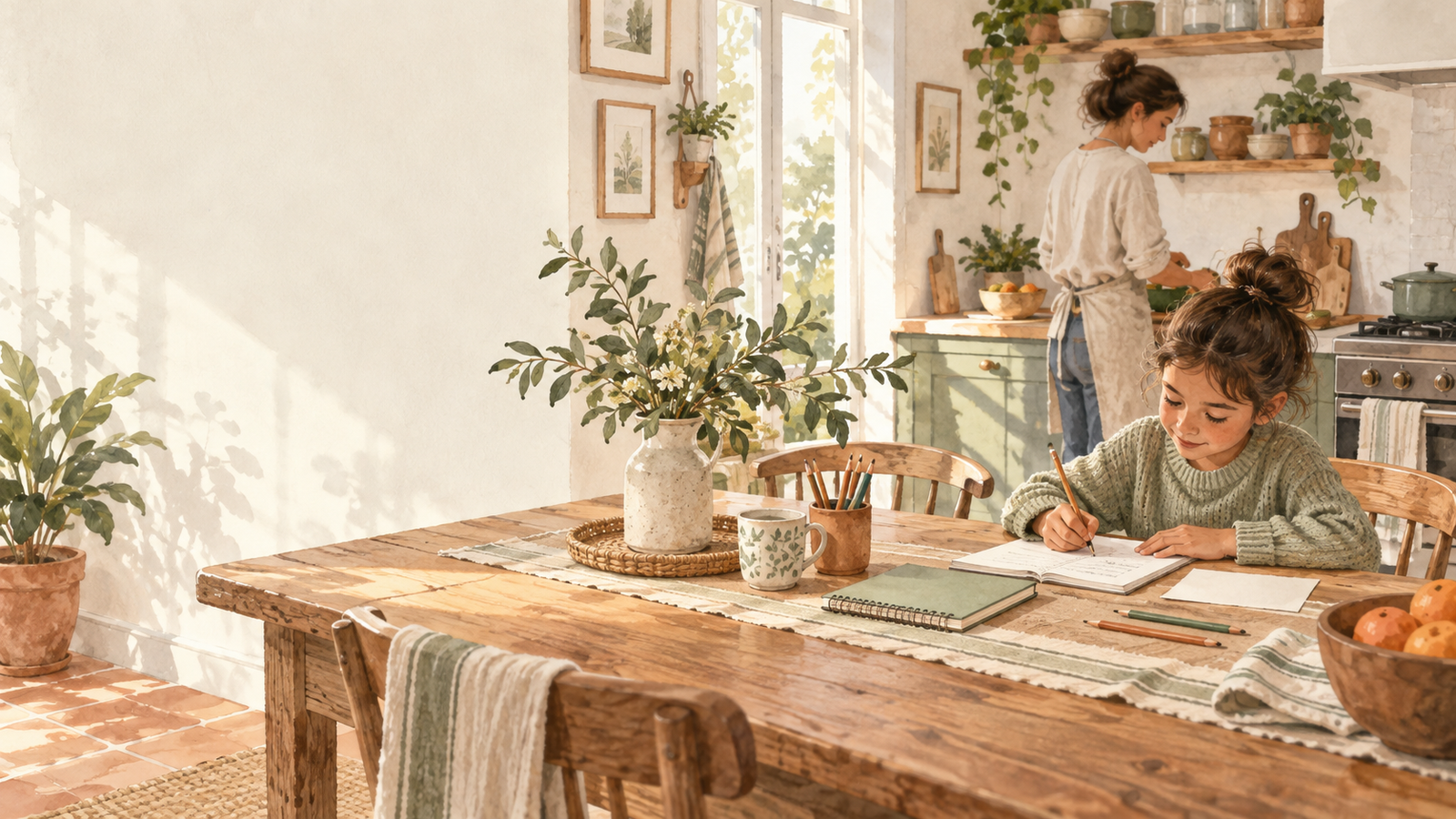
The best homework space may be a desk. It may also be the end of the kitchen table, a tray in the living room, or a portable basket that appears after school and disappears before dinner.
What matters is not perfection. What matters is reducing friction.
A “Good” Study Space Looks Different for Different Children
Some children focus best in a quiet bedroom. Others sit in their rooms and become distracted by toys, books, clothes, or the feeling of being alone.
Some children need a parent nearby to answer a question or quietly keep them on track. Others work better when no one is watching every sentence they write.
The right place is the place that suits the child and the family.
The Child Mind Institute recommends involving children in the decision about where homework happens and discussing the advantages and disadvantages of different locations together. Some children need privacy; others may do better at a communal space such as the dining table. Their homework guidance explains this approach in more detail.
Instead of asking, “Where is the perfect study room?” ask:
- Where can my child sit comfortably?
- Where is there enough light?
- Where will they be least distracted?
- How close do they need me to be?
- What distractions can we reduce during homework time?
- Can this setup be repeated most days?
A consistent place can help, but it does not need to be permanent.
The Kitchen Table Counts
Families sometimes dismiss a shared table because it does not look like a traditional homework station.
But a kitchen or dining table can be an excellent study space.
It often has good lighting, enough room to spread out materials, and a parent nearby without requiring the parent to sit and supervise every moment. For a younger child, that closeness can make the transition into homework feel less lonely or overwhelming.
The American Academy of Pediatrics notes that children do not necessarily need a desk in their bedroom. A regular location and time matter more; the kitchen table can work well when it is quiet, well lit, and free from television and other distractions. Read the AAP’s homework-habit guidance here.
The key is to make the table feel prepared for work.
Clear away the dinner dishes, put away unrelated clutter, and give the child a defined area. A placemat, desk pad, or simple tray can signal: this is where I work for now.
When homework is finished, the materials can be put away and the table can return to family life.
That flexibility is not a failure of the system. It is what makes the system work.
Create a Portable Homework Kit
A dedicated desk is optional. A portable homework kit is not.
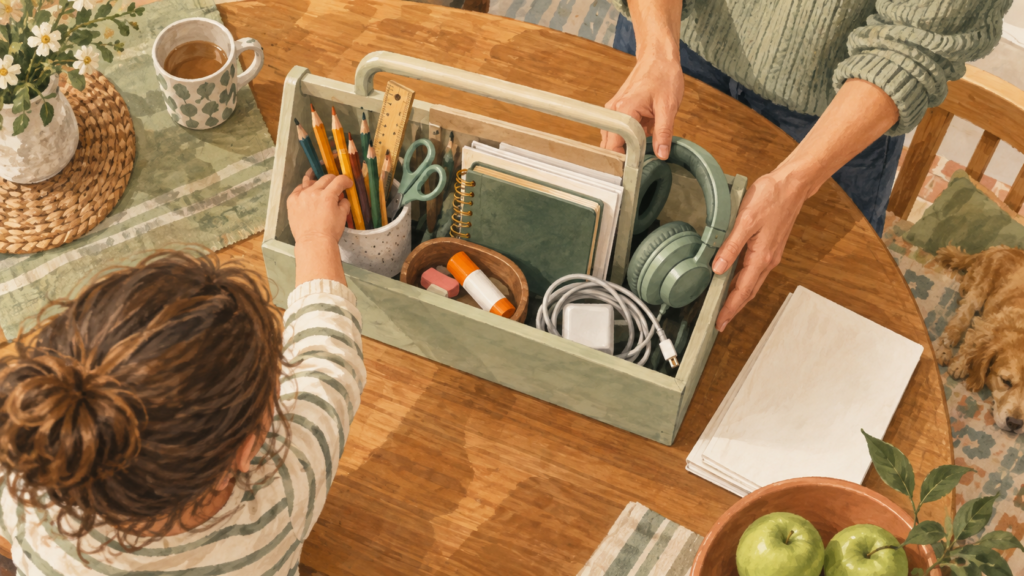
When pencils, paper, scissors, rulers, headphones, chargers, and homework folders are spread through the house, the child starts every assignment with a scavenger hunt. That makes beginning harder than it needs to be.
Keep the essentials in one open basket, handled caddy, drawer, or zip pouch:
- Pencils and erasers
- Colored pencils or markers
- Lined paper
- Blank paper
- Ruler
- Scissors
- Glue stick
- Calculator, if needed
- Headphones
- Charging cable
- A small notepad for reminders
The Child Mind Institute recommends keeping necessary materials ready in the child’s chosen homework location. If a shared table is used, supplies can stay in a portable bin or crate. Their practical homework-space advice is here.
This is a small change, but it protects the child’s attention.
A child who can sit down, open a folder, and begin is already more likely to feel capable.
Make Starting Easier Than Avoiding
For many children, the hardest part of homework is not the assignment itself.
It is the transition.
They have spent the day following directions, managing friendships, sitting still, processing noise, and moving from one activity to another. Coming home may bring hunger, tiredness, or a strong desire to play.
Before expecting focus, make room for the transition.
Some children need a snack, movement, and a short break after school. Others do better beginning homework while they are still in a school mindset. There is no universally correct time. The AAP suggests choosing a time that works for the child and the family, then keeping it reasonably consistent. See the full guidance here.
Try a simple sequence:
- Arrive home
- Put the backpack in one consistent place
- Have a snack or take a short movement break
- Review what needs to be done
- Begin with one small task
The child does not need to love this routine. They only need to know what happens next.
A ten-minute warning can also help: “In ten minutes, we will clear the table and look at your homework.” That is often more effective than suddenly announcing that it is time to work.
Keep the Visual Environment Calm
A study space does not need to be empty or sterile.
But it should not compete with the work.
A large collection of toys, an active television, several open screens, loud conversations, or a cluttered surface can make it harder for children to settle. This is especially true for children who already find planning, transitions, or attention difficult.
The goal is not to create silence at all costs. Family homes are not libraries.
The goal is to remove the distractions you can control:
- Turn off the television during homework time.
- Keep phones outside arm’s reach unless they are needed for schoolwork.
- Close unrelated browser tabs.
- Clear the immediate work surface.
- Put away tempting toys for the length of the work session.
- Use headphones or gentle background sound only if it genuinely helps your child.
The Child Mind Institute notes that multitasking with phones and entertainment can make schoolwork take longer and recommends planned, separate breaks rather than constant digital interruptions. Read their explanation of technology and concentration here.
For many families, the most useful rule is simple: one screen, one task.
Comfort Matters More Than Matching Furniture
Children do not need expensive furniture to study well.
They do need a setup that is physically workable.
A chair that is roughly the right height, a table that allows them to write without hunching over, and enough light to see the page all matter more than a perfectly styled desk.
If your child is working at a table that is too high, try a footstool or a firm box under their feet. If the chair feels uncomfortable, add a small cushion. If the lighting is dim, bring over a lamp.
These small adjustments tell a child: your body deserves to be comfortable while you learn.
For children with different physical, sensory, or learning needs, flexibility matters even more. The National Association for the Education of Young Children emphasizes that accessible materials and environments can support children’s independence and participation. Read NAEYC’s guidance on accessible learning environments here.
A child does not need to study exactly like a sibling, a friend, or a child in a magazine photograph.
Let the Child Have Some Ownership
Children are more likely to use a space when they feel it belongs to them.
That does not mean they need to decorate every wall. It means they can make a few meaningful choices.
Let them choose:
- Their pencil cup or supply caddy
- A favorite desk pad or placemat
- A family photo or small piece of art nearby
- The color of a folder
- Whether they work at the table or desk when both are available
- Whether they begin with reading, math, or another manageable task
Small choices give children a sense of agency without making them responsible for designing the entire system.
A child who says, “This is where my homework stuff goes,” is more likely to return materials there.
Be Nearby Without Taking Over
Parents often feel torn during homework.
If they step away, they worry the child will become distracted. If they sit too close, homework can turn into a power struggle or a parent’s assignment.
A middle ground can help.
Stay available. Ask your child to tell you what the assignment is. Help them understand directions when needed. Break a large task into a smaller first step.
Then let them try.
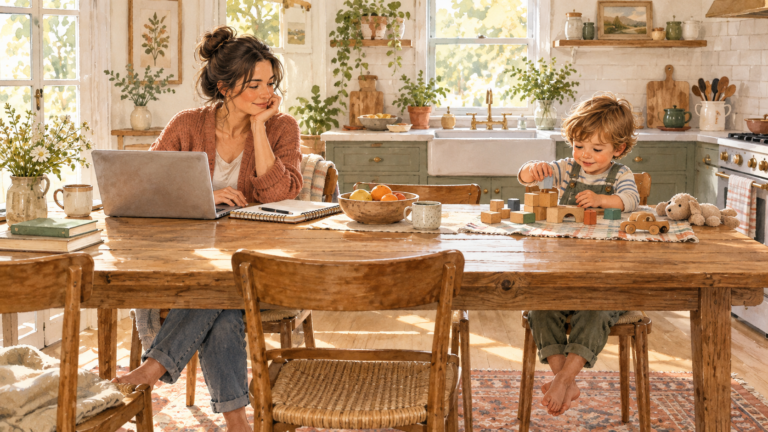
For younger children, this may mean sitting nearby while you prepare dinner or pay bills. For older children, it may mean checking in after fifteen or twenty minutes rather than staying at the table the entire time.
Your role is not to make every answer perfect.
Your role is to help the child build the habits of beginning, asking for help, returning to a task, and finishing.
If homework consistently takes far longer than expected, causes intense distress, or becomes a daily battle, speak with the child’s teacher. A teacher can clarify expectations, identify whether an assignment is too difficult, and suggest support that fits the classroom.
A Simple End-of-Day Reset
The study space does not need a complicated cleanup process.
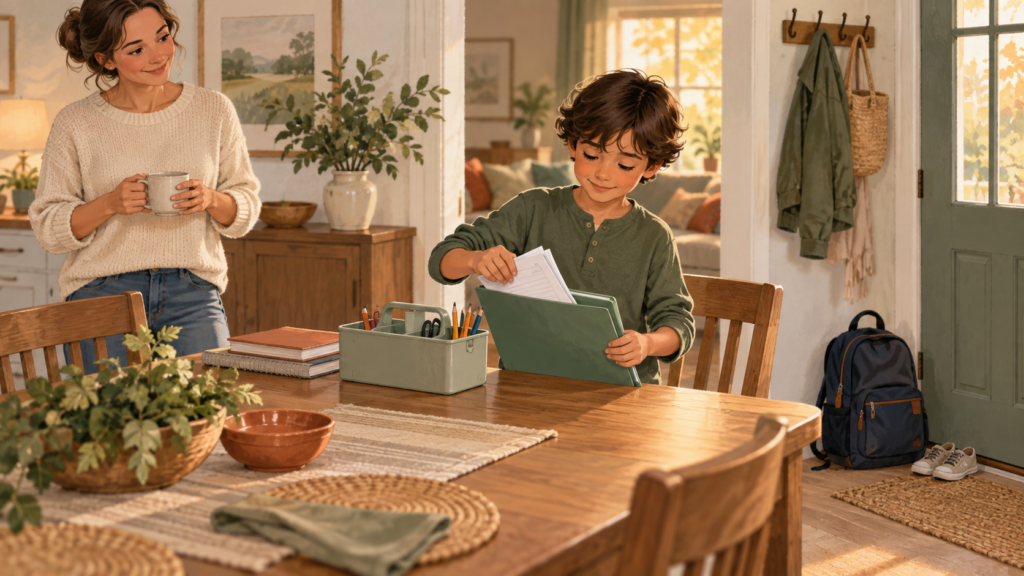
At the end of homework, try a three-minute reset:
- Put finished work in the correct folder.
- Return pencils and supplies to the homework kit.
- Put the backpack in its usual place.
- Clear the table or desk.
This helps tomorrow begin more easily.
It also prevents school materials from spreading across the home and becoming another source of stress for everyone.
A simple routine with a clear beginning and end can be especially helpful for children who struggle with organization. The Child Mind Institute notes that checklists and consistent routines can reduce the mental load of deciding what to do next. Read their executive-function guidance here.
You Do Not Need to Build a Perfect Learning Corner
A beautiful study space can be lovely.
But it is not the reason a child learns.
Children learn when they have enough support to begin, enough calm to stay with a task, enough access to the materials they need, and enough trust that they can ask for help when they are stuck.
A kitchen table can do that.
A portable supply basket can do that.
A parent sitting nearby can do that.
Start with what your home already has. Make one small improvement. Clear one surface. Gather the supplies. Agree on a routine.
The goal is not a perfect workspace.
The goal is a child who feels that learning at home is possible.




One Comment