When the Kitchen Table Has to Do Everything: A Shared Family Space That Works
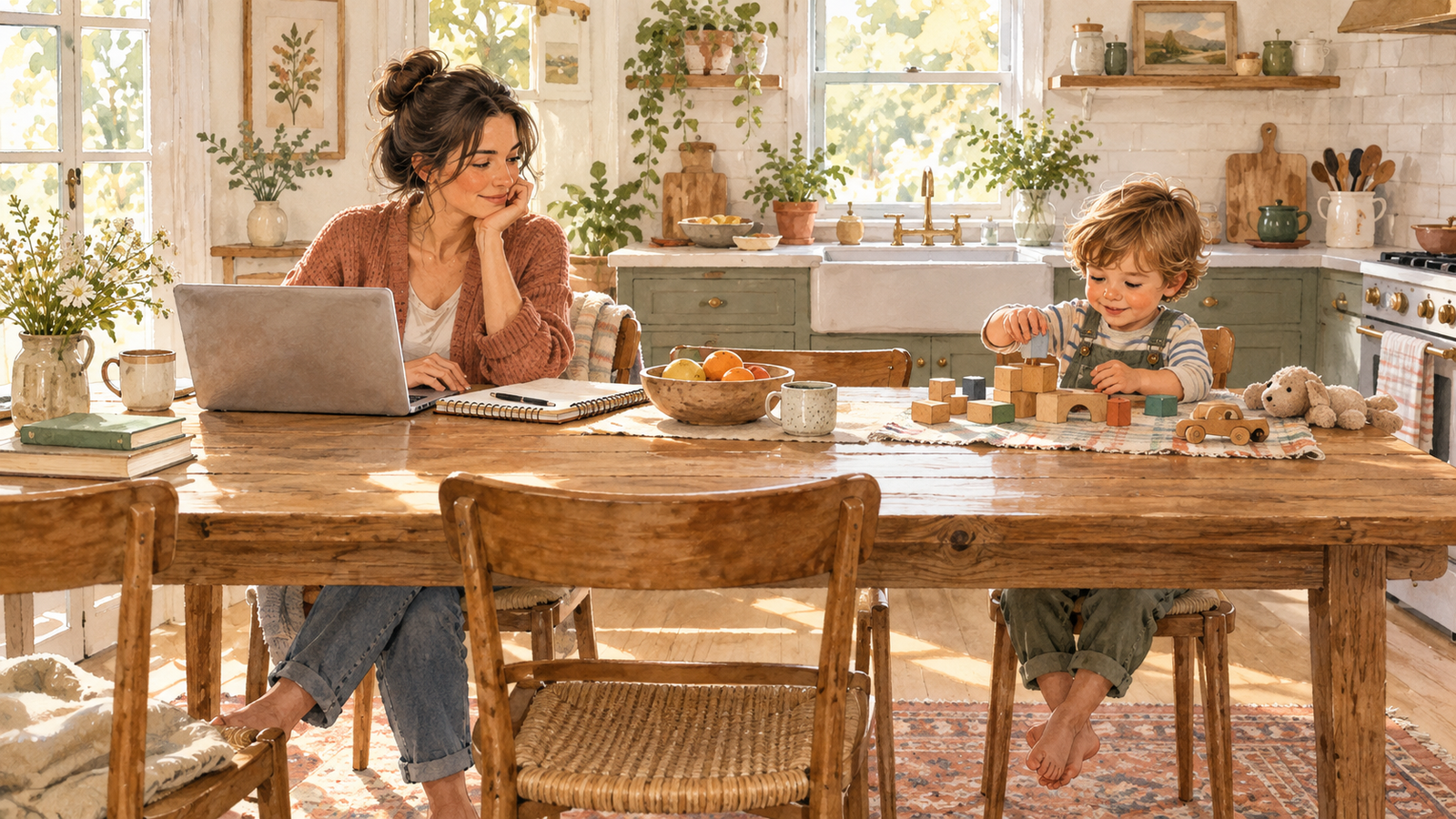
When my son was a toddler, I often opened my computer at the kitchen table while he played nearby. I would start a paragraph, get up for a snack or to help him, return to the same paragraph, and hear him call again. Some days the table was my desk, his play surface, the place where we ate, and the place where the day’s unfinished things collected.
That experience changed the way I think about a “family-friendly” room. A home does not become more welcoming just because it has a designated playroom, a beautiful desk, or matching bins. Many families ask one space to do several jobs. The question is not how to make the room look unused. It is how to help it change roles without making every transition a project.
Start with the life already happening there
Before buying anything, spend a day noticing what lands on the table. Is it homework after school? A laptop during a short work window? Crayons while dinner is being prepared? Mail that has no other home? A place where someone wants to talk while you are still finishing a task?
This small observation prevents a common mistake: organizing for an imagined routine instead of the one your family actually has. If dinner happens at the table every night, the table needs a way to become ready for dinner. If your child plays there only while an adult is nearby, it does not need to hold a permanent activity station.
A shared family space works better when its uses can change. That may mean keeping one end clear, choosing materials that can be put away in a minute, or placing a small basket within reach. It does not require turning the whole room into a children’s room.
Give the table a job for this moment
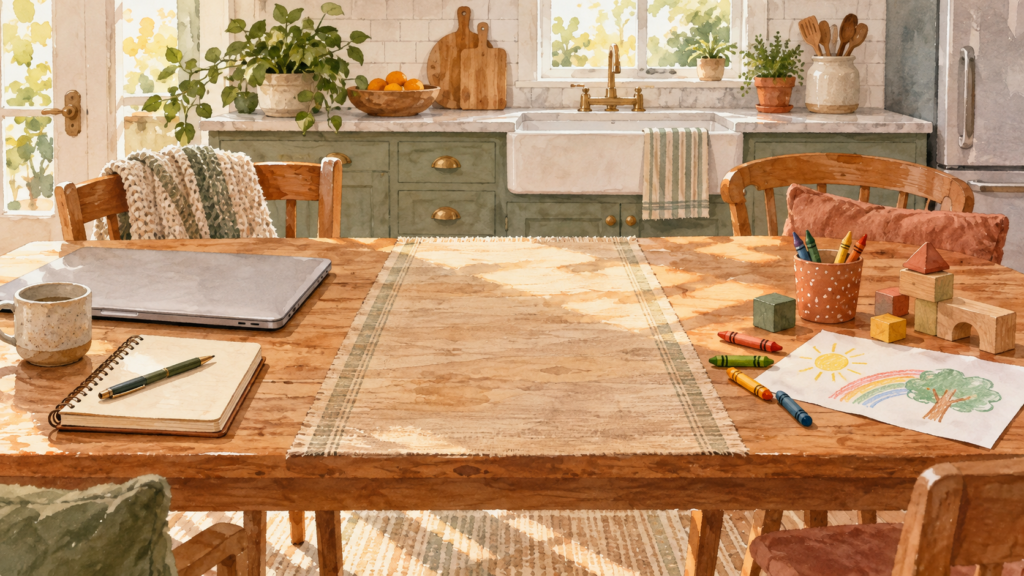
I find it easier to think in time periods than in permanent zones. At one moment the table is for breakfast. Later it may hold a laptop and a child’s drawing. In the evening it becomes a place to eat and talk. The room has not failed because it looks different at noon than it did at eight in the morning.
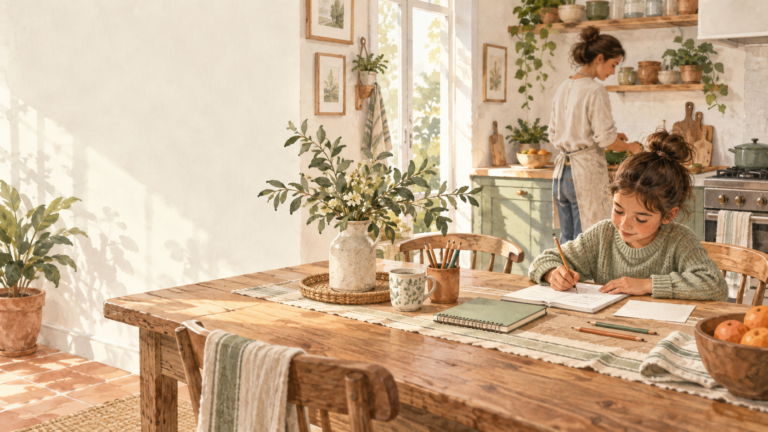
One simple approach is to name the current activity and keep only what belongs to it on the surface. If it is time for a child to draw while an adult prepares food, paper and a few crayons may be enough. If it is homework time, bring out the assignment and one pencil before hauling over the entire backpack. If an adult needs to work, clear a modest place for the laptop and any papers that truly need to stay open.
The point is not a spotless tabletop. It is fewer decisions when the next activity begins. A small clear patch in the middle can do more for a transition than an elaborate storage system in another room.
If homework is the main challenge in your home, A Homework Space Does Not Need to Be Perfect to Help Kids Focus looks more closely at supporting a child during that part of the day.
Put the most-used things where the next person can find them
Accessible does not mean leaving everything out. It means making the next step obvious. A small container for paper and crayons, a spot for the current homework folder, and a place for the adult’s laptop may be enough to keep one activity from swallowing the next.
Keep age and safety in mind. A toddler’s accessible materials should be appropriate for their age, and cords, sharp tools, tiny pieces, and hot drinks need adult attention and safe placement. If storage involves a tall piece of furniture, the U.S. Consumer Product Safety Commission recommends anchoring it to prevent tip-overs. A simple space is only useful if children can use it safely.
The American Academy of Pediatrics also notes that children’s play need not depend on an elaborate setup. Everyday materials, conversation, and a caregiver’s presence can be enough to make play meaningful. That takes pressure off the idea that a child needs a fully equipped “activity area” beside every adult task.
A basket is not childcare
This is the boundary I wish I had understood more clearly when my son was little: making play materials available does not make uninterrupted work possible. A toddler may play nearby for a few minutes and then need help, connection, or supervision. The table arrangement cannot solve a mismatch between a job’s demands and a child’s care needs.
If a task truly requires sustained concentration, a phone call, or confidential work, it may require another adult, childcare, a different time window, or an honest conversation about expectations when those options are not available. Not every family can arrange that easily. The difficulty is real; it is not a decorating failure.
For a child who can play independently for a while, a nearby surface can still be useful. It lets us share space and notice each other. Harvard’s Center on the Developing Child emphasizes the value of responsive back-and-forth with children. The goal is not for the adult to narrate every minute of play, but to remain available to notice and respond when connection is needed.
Make the reset easy enough to repeat
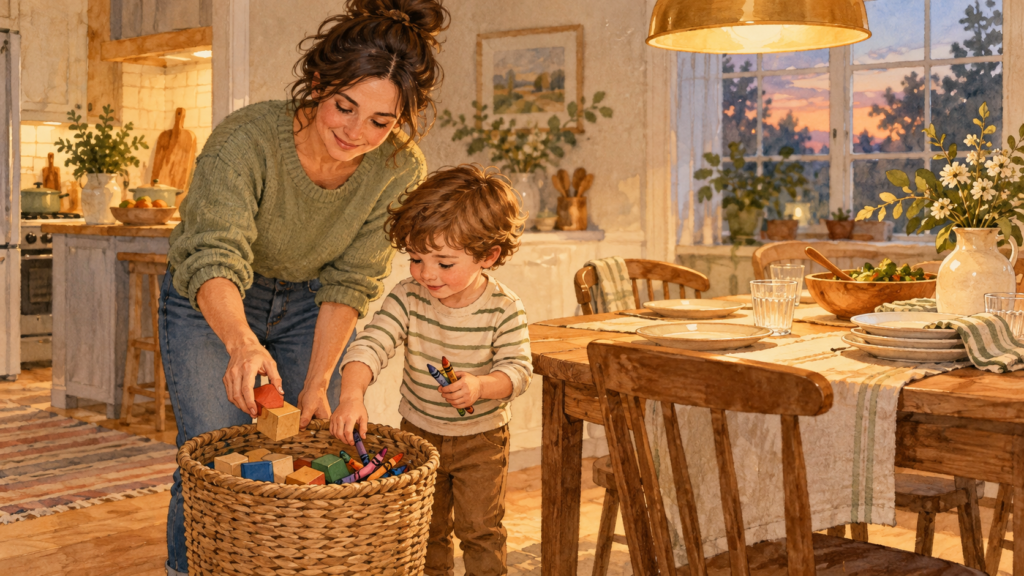
A table used by everyone will need resetting. I prefer a reset small enough to happen before dinner: close the laptop, return the handful of play materials, wipe the surface, and make room for plates. A child can help with a task that fits their age, such as putting blocks in a basket. Some evenings that will happen neatly; others it will not.
The reset is not a moral test. It is a transition cue. When the work materials leave, the table can be ready for a meal. When homework moves to its spot, a child does not have to stare at it through dinner. When art supplies are easy to retrieve tomorrow, putting them away today does not feel like the end of creative time.
Let the room serve the people, not the photo
The most useful shared space in our home has not always been the most beautiful one at a given hour. It has been the one where a child could play close by, where an adult could sometimes finish a task, where a conversation could interrupt the plan, and where we could clear a place to eat together again.
You do not need to solve every family need with a new room or a new purchase. Notice what the space already does. Choose one friction point. Make the next transition a little easier. Then let the table look lived in—because it is.
References and further reading
- American Academy of Pediatrics: Indoor Play Ideas
- Harvard Center on the Developing Child: Serve and Return
- U.S. Consumer Product Safety Commission: Anchor It!
The opening example is Lucy’s personal experience. The illustrations are artistic representations, not photographs of her home.