When Kids Say “I’m Bored”: Why Parents Do Not Need to Fix Every Quiet Moment
“I’m bored” can make a parent feel as though something has gone wrong.
Maybe the day has been too quiet. Maybe there are too few toys. Maybe we should suggest an activity, turn on something educational, plan an outing, find a craft, or solve the feeling immediately.
But boredom is not always a problem to fix.
It can be an uncomfortable pause — and sometimes that pause is where children begin to make their own plans, gather materials, negotiate with siblings, invent games, or discover what they actually feel like doing.
The goal is not to abandon a child with an impossible amount of empty time. It is to stop treating every unscheduled minute as an emergency.
Boredom is a feeling, not a failure
Children are used to adults organizing much of their world: school, activities, meals, transitions, transportation, and often entertainment. When the structure drops away, they may not immediately know what to do next.
That does not mean they are incapable of independent play. It means they may need time to shift gears.
The Child Mind Institute explains that unstructured time can help children practice planning, flexibility, organization, problem-solving, creativity, and tolerance for mild frustration. The benefit is not the bored feeling itself; it is what children learn when they begin to respond to it. The Benefits of Boredom
A child can dislike being bored and still learn something valuable from not being instantly rescued.

Do not confuse a suggestion with a solution
When a child says, “I’m bored,” parents often begin listing options:
“Read a book. Go outside. Build something. Draw. Play with your toys.”
Sometimes that helps. Often, it produces a new round of “No.”
Instead, acknowledge the feeling first:
“It is hard when you do not know what you want to do.”
Then return a little responsibility:
“I’m here if you need help getting started, but I trust you can find something.”
This is not coldness. It is confidence.
For younger children, one gentle prompt may be enough: “Would you like to begin with blocks, paper, or being outside?” For older children, an open-ended challenge can help: “Could you make something useful from this box?” or “What would make this room feel different by the time we have dinner?”
The key is not to provide a pre-made activity. It is to provide a starting point.
Keep open-ended materials available
Children are more likely to find their own direction when some materials are easy to reach:
- cardboard boxes;
- tape and child-safe scissors;
- paper and crayons;
- blocks;
- fabric scraps;
- toy animals or figures;
- books;
- simple dress-up items;
- outdoor tools such as chalk, buckets, or magnifying glasses.
These do not need to be displayed perfectly. A small, accessible collection is enough.
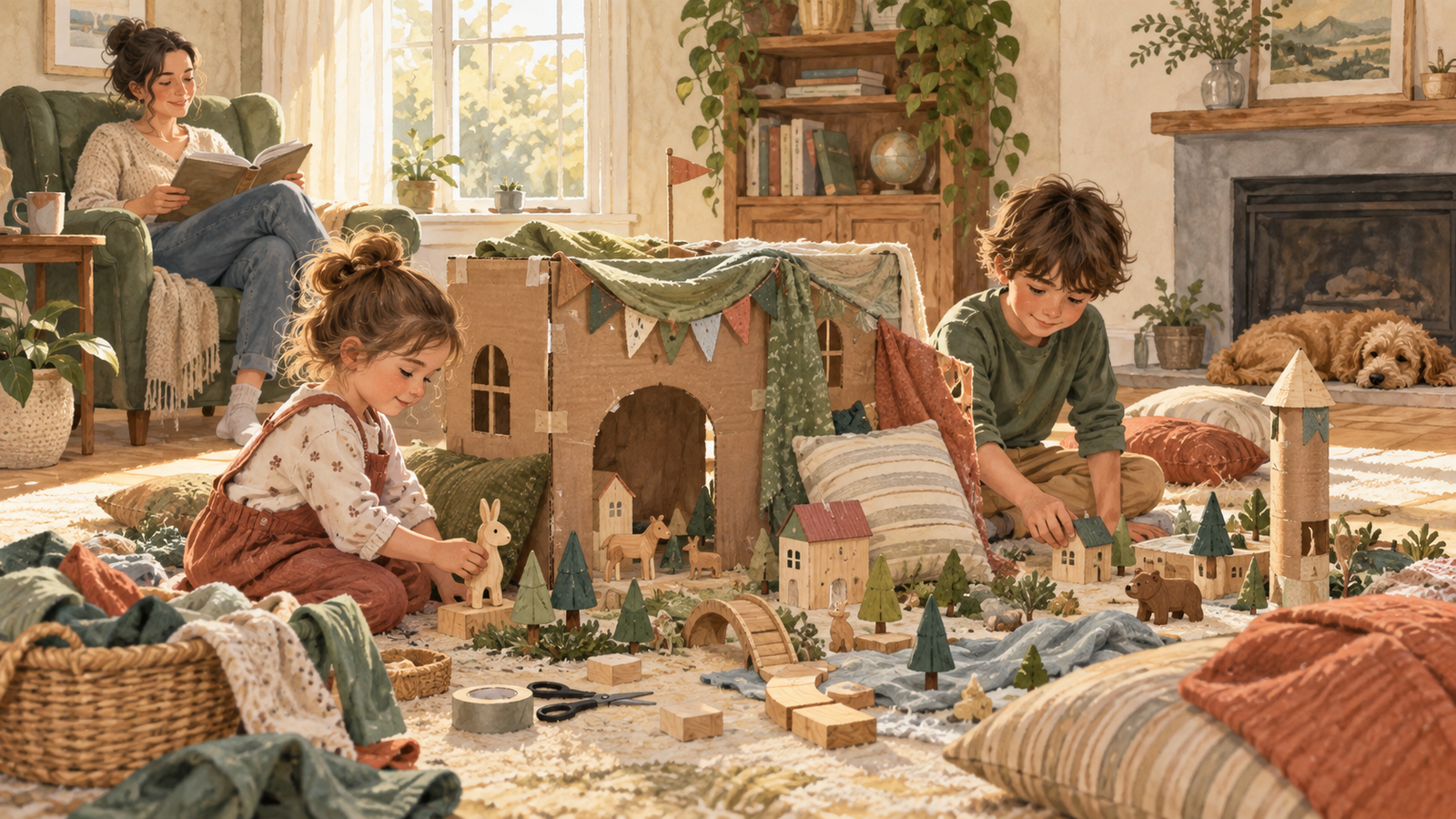
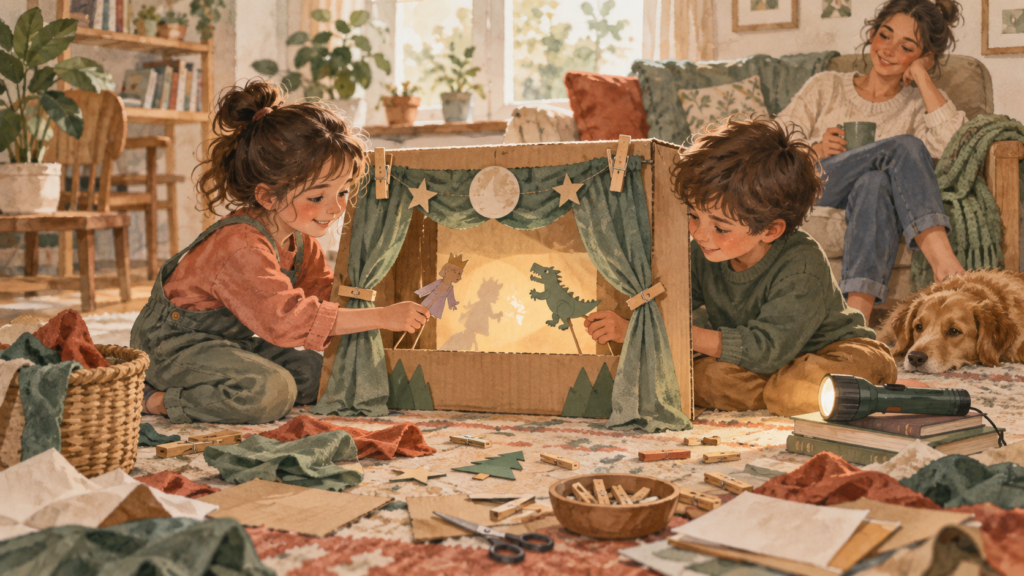
The most interesting play often comes from materials that do not have one intended use. A box can become a theater, a shop, a home, a spaceship, a pet hospital, or a tunnel. The child has to decide.
A little help is still help
There is a difference between refusing to engage and doing the whole creative work for a child.
If a child is truly stuck, sit nearby for five minutes. Help them gather the first materials. Ask what they might do first. Then step back before the activity becomes yours.
You might say:
- “I can help you set up, but you choose what happens next.”
- “Let’s find three things you could use.”
- “What kind of problem do you want your characters to solve?”
- “I wonder what would happen if you combined those two ideas.”
This kind of support teaches children how to start, not just how to follow directions.
Boredom is not appropriate in every moment
Children who are hungry, overtired, lonely, anxious, sick, overwhelmed, or asking for connection may need something different from a lecture about creativity.
Look at the context.
A child who has spent a long day at school may need a snack, movement, comfort, or a few minutes of undivided attention before they can play independently. A child who repeatedly seems withdrawn or distressed deserves careful listening.
Unstructured time is valuable when it exists inside a relationship where a child feels safe and supported.
Let their idea be imperfect
Independent play can be noisy, messy, and less efficient than the adult version. That is often the point.
A cardboard fort may lean. The puppet show may have no plot. A child may spend forty minutes arranging chairs and never use them for the game they originally imagined.
Try not to improve it too quickly.
When adults resist correcting every detail, children learn that their ideas can lead somewhere. They also learn that a plan can change without being ruined.
A quieter home does not have to be an unengaged home
You can be present without performing.
Read nearby. Fold laundry. Cook dinner. Garden. Sit on the porch. Let children see that adults also know how to inhabit quiet time.
That is a useful model in itself.
A childhood with room for boredom is not an empty childhood. It is one with space for initiative, imagination, and the slow beginning of an idea that belongs entirely to the child.
Source and further reading
- Child Mind Institute: The Benefits of Boredom
- Child Mind Institute: Finding the Balance With After-School Activities