
Best STEM Toys for 5-Year-Olds: 15 Fun & Educational Picks
Finding the best STEM toys for a 5-year-old can be surprisingly difficult.
At this age, children are naturally curious. They want to know how things work, why things move, what happens when they change something, and whether they can build something on their own.
That is exactly why STEM toys can be so valuable.
The best STEM toys for young children don’t feel like schoolwork. Instead, they encourage kids to build, experiment, observe, solve problems, make mistakes, and try again — all while having fun.
We’ve put together 15 STEM toy ideas that cover everything from construction and magnets to science experiments, math, coding, geography, and geology.
Whether your child loves building things, solving puzzles, exploring nature, or asking endless questions, there is something on this list worth considering.
Disclosure: This article contains affiliate links. If you purchase something through one of our links, we may earn a commission at no additional cost to you.
Quick Look: Best STEM Toys for 5-Year-Olds
| Item | Toy Name | Best For |
|---|---|---|
| 1 | LEGO Classic Creative Brick Box | Building & creativity |
| 2 | PicassoTiles Magnetic Tiles | Construction & geometry |
| 3 | Doctor Jupiter My First Science Experiments Kit | Science & experimentation |
| 4 | Learning Resources Super Magnet Lab Kit | Magnets & science |
| 5 | Educational Insights GeoSafari Jr. My First Microscope | Nature & observation |
| 6 | Circuits Science Kit | Electricity & engineering |
| 7 | LeapFrog Magic Adventures Globe | Geography & exploration |
| 8 | Number Hunter Math Board Game for Kids | Math & problem-solving |
| 9 | Qirptey Kids STEM Building Toys | Construction & creativity |
| 10 | Learning Resources Gears Deluxe Building Set | Mechanical thinking |
| 11 | ThinkFun Gravity Maze Builder | Logic & spatial reasoning |
| 12 | Plus-Plus Building Blocks | Creativity & construction |
| 13 | Osmo Coding Family Bundle | Coding & technology |
| 14 | Botley Coding Robot | Early coding & logic |
| 15 | NATIONAL GEOGRAPHIC Mega Gemstone Dig Kit | Geology & discovery |
Quick Recommendations
Best for Building: LEGO Classic Creative Brick Box
Best for Open-Ended Construction: PicassoTiles Magnetic Tiles
Best for Science: Doctor Jupiter Science Experiments Kit
Best for Nature & Observation: GeoSafari Jr. My First Microscope
Best for Coding: Botley Coding Robot
Best for Logic: ThinkFun Gravity Maze Builder
Best for Geology: National Geographic Mega Gemstone Dig Kit
What Makes a Good STEM Toy for a 5-Year-Old?
A good STEM toy doesn’t necessarily need to be complicated.
For a five-year-old, some of the best learning experiences come from simple activities that allow children to experiment independently.
Look for toys that encourage:
- Problem-solving
- Creativity
- Hands-on experimentation
- Spatial reasoning
- Cause-and-effect thinking
- Observation
- Early math skills
- Construction and engineering
- Logic and sequencing
- Curiosity about the world
Another important factor is whether the toy can be used in different ways.
Open-ended toys can be particularly interesting because children aren’t limited to completing one specific activity. They can build something, take it apart, change their approach, and try again.
How We Chose These STEM Toys
Choosing a STEM toy for a 5-year-old is about more than finding something labeled “educational.” We looked for toys that encourage children to be curious, active, and involved in the learning process rather than simply following instructions or watching a screen.
For this list, we considered several factors, including hands-on play, problem-solving, creativity, logic, observation, experimentation, spatial reasoning, and early STEM skills. We also looked for toys that give children opportunities to make choices, try different approaches, and discover what happens when they change something.
We included a mix of building sets, science kits, magnetic toys, math games, microscopes, coding toys, geography activities, and hands-on discovery kits. This variety is intentional because children learn and play in different ways. A child who loves building may be drawn to LEGO or magnetic tiles, while another may be more interested in experiments, nature, coding, or puzzles.
We also gave preference to toys that can be used repeatedly and in different ways. Open-ended activities can be especially valuable because children can build, experiment, make mistakes, redesign their ideas, and try again. The goal is not simply to complete a project, but to encourage the kind of curiosity that makes a child ask, “What happens if I try it this way?”
A note for parents: Every child develops at their own pace, so age recommendations, supervision needs, and the type of play a child enjoys should always be considered before choosing a toy.
1. LEGO Classic Creative Brick Box
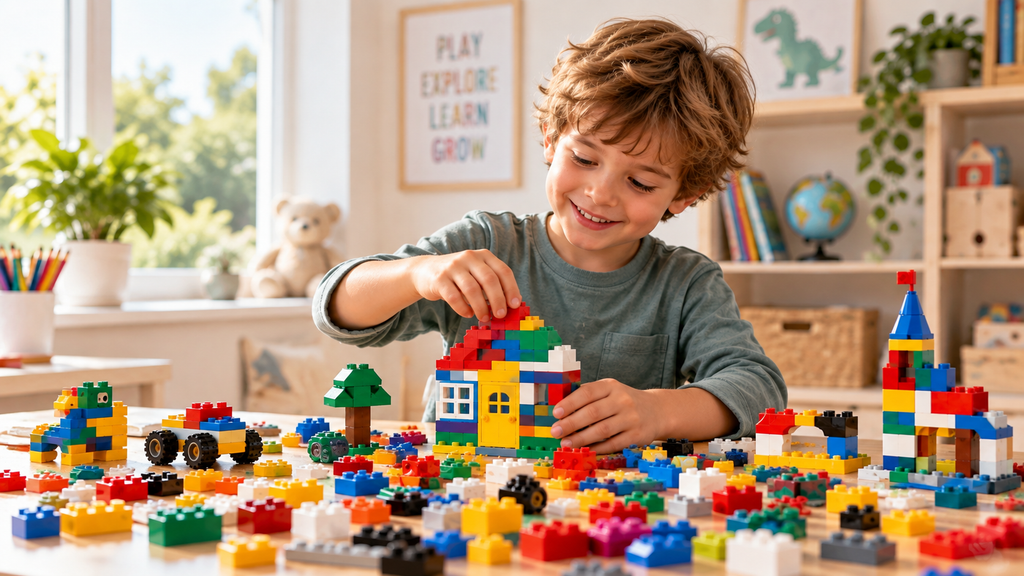
LEGO Classic is a great choice for 5-year-olds who love to build, take things apart, and create their own ideas. Instead of being limited to one finished model, children can use the bricks to build houses, vehicles, animals, towers, robots, and almost anything they can imagine.
The Large Creative Brick Box includes 790 pieces in a wide variety of shapes and 33 colors, along with windows, doors, wheels, baseplates, and other special pieces. This variety gives children plenty of options to experiment with different designs and turn simple ideas into more detailed creations.
What makes it especially useful as a STEM toy is the process of building itself. Children naturally practice spatial reasoning, planning, problem-solving, and cause-and-effect thinking as they figure out how pieces fit together and how to make their structures work. If a tower falls or a vehicle doesn’t look the way they imagined, they can change the design and try again.
Best for: Building, creativity, spatial reasoning, and problem-solving.
Why it stands out: Its open-ended design gives children the freedom to create instead of simply following a set of instructions. The same collection of bricks can become something completely different every time they play.
Try this: Give your child a simple challenge, such as building the tallest tower they can make. Then ask, “What could you change to make it stronger?” This turns a simple building activity into a fun introduction to stability, balance, and problem-solving.

2. PicassoTiles Magnetic Tiles
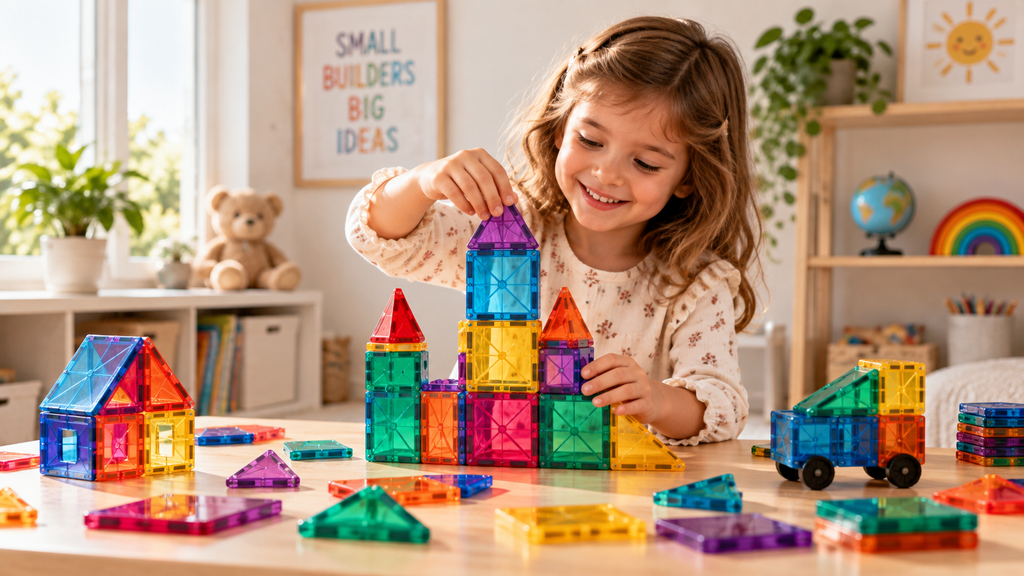
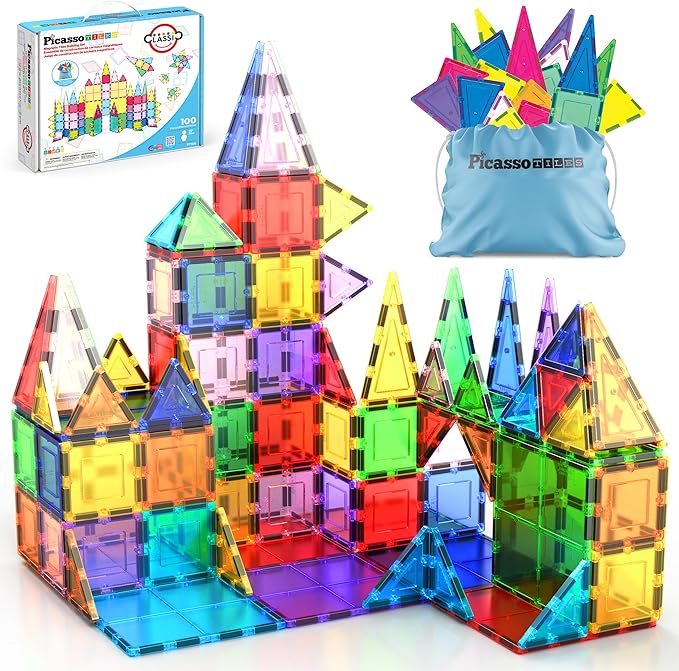
PicassoTiles Magnetic Tiles are a fun way for kids to explore building, shapes, and simple geometry through hands-on play. The magnetic pieces connect easily, allowing children to create flat patterns as well as towers, houses, castles, and other three-dimensional structures. Because there isn’t just one correct way to use the tiles, children can keep changing their designs and discovering new possibilities.
As children build, they naturally begin experimenting with balance, symmetry, size, and structure. They may discover that adding another piece makes a tower stronger, that certain shapes fit together in unexpected ways, or that a structure needs to be redesigned when it falls. This makes magnetic tiles a particularly engaging introduction to spatial reasoning and early engineering concepts.
Another advantage is that magnetic tiles can grow with a child’s creativity. A simple build can eventually become a more elaborate house, city, vehicle, or imaginary world. Many PicassoTiles sets are also compatible with other full-sized PicassoTiles sets, making it possible to expand the collection over time.
Best for: Construction, geometry, spatial reasoning, and creative problem-solving.
Why it stands out: The magnetic connections make it easy for children to build, take apart, and rebuild quickly. This encourages experimentation without making the building process frustrating.
Try this: Challenge your child to build a bridge that can hold a small toy car. Then ask, “What could we change to make the bridge stronger?” It’s a simple way to turn open-ended play into a hands-on engineering challenge.
3. Doctor Jupiter My First Science Experiments Kit
Doctor Jupiter My First Science Kit is a fun introduction to science for kids who are always asking questions and wanting to know how things work. With more than 100 experiments to explore, the kit gives children the opportunity to investigate different scientific ideas through hands-on activities rather than simply reading about them.
The experiments are designed to be approachable for young children and include colorful activities such as walking water and water fireworks. Illustrated, step-by-step instructions also make it easier for parents and children to work through the activities together.
What makes this kit especially interesting for STEM learning is the opportunity to follow a simple scientific process: make a prediction, try an experiment, observe what happens, and talk about the result. Even when the outcome isn’t what a child expected, that surprise becomes part of the learning experience.
It can also be a great way to turn an ordinary afternoon into a small science session at home. Some experiments may require common household ingredients, so parents should check the instructions before starting and supervise the activities as recommended.
Best for: Science exploration, observation, experimentation, and curious kids.
Why it stands out: With a large variety of experiments, children can explore different scientific ideas instead of repeating the same type of activity. It makes science feel more like discovery than a lesson.
Try this: Before starting an experiment, ask your child, “What do you think is going to happen?” Write down or remember their prediction, then compare it with what actually happened. This simple habit introduces the basic idea of making a hypothesis and testing it.


4. Learning Resources Super Magnet Lab Kit
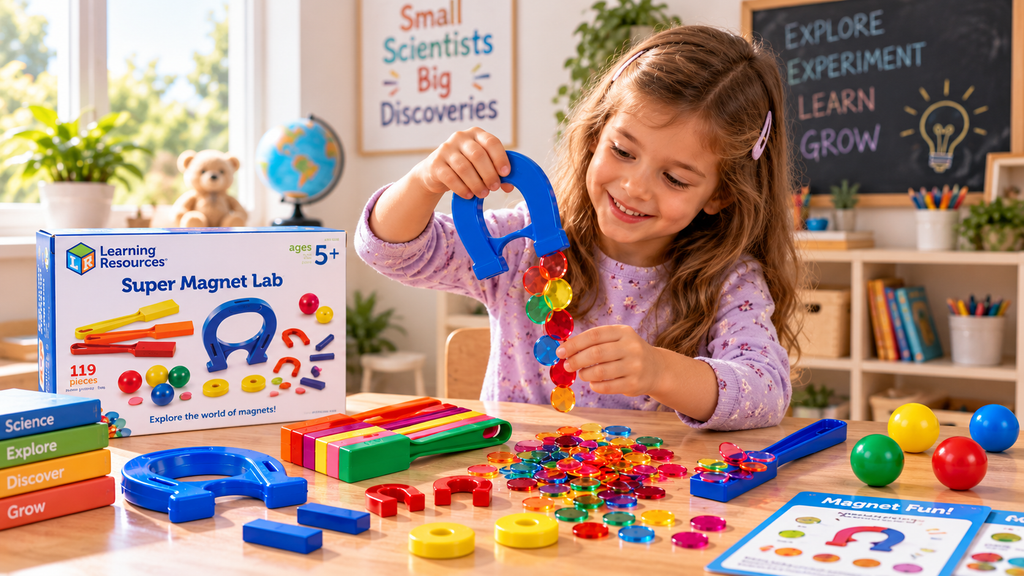
The Learning Resources Super Magnet Lab Kit gives kids a hands-on way to discover how magnets behave. Instead of simply learning that magnets attract certain materials, children can experiment with different types of magnets and observe attraction, repulsion, and magnetic forces in action.
With 119 pieces, the kit includes magnetic wands, chips, marbles, bar magnets, ring magnets, and horseshoe magnets, giving children plenty of ways to explore. An activity guide provides structured experiments to get started, while the different components also allow for more open-ended investigation once children become familiar with the basics.
What makes this kit interesting for STEM learning is that magnetism isn’t something children can see directly. They have to observe what happens when magnets get closer or farther apart and figure out how their position changes the result. This creates a natural opportunity to explore cause and effect, observation, prediction, and scientific reasoning.
It’s also a good option for parents who want a screen-free activity that can be explored together. You can start with one simple question—“What do you think will happen?”—and let your child test the idea rather than immediately giving them the answer.
Best for: Magnetism, scientific investigation, cause and effect, and curious kids.
Why it stands out: The kit offers several different types of magnetic pieces, allowing children to compare how magnets behave instead of repeating just one activity. The combination of guided experiments and open-ended exploration gives the toy more replay value.
Try this: Give your child a few everyday objects and ask which ones they think a magnet will attract. Let them make their predictions first, then test each object and compare the results. This simple game introduces the idea of making a prediction and using evidence to check it.

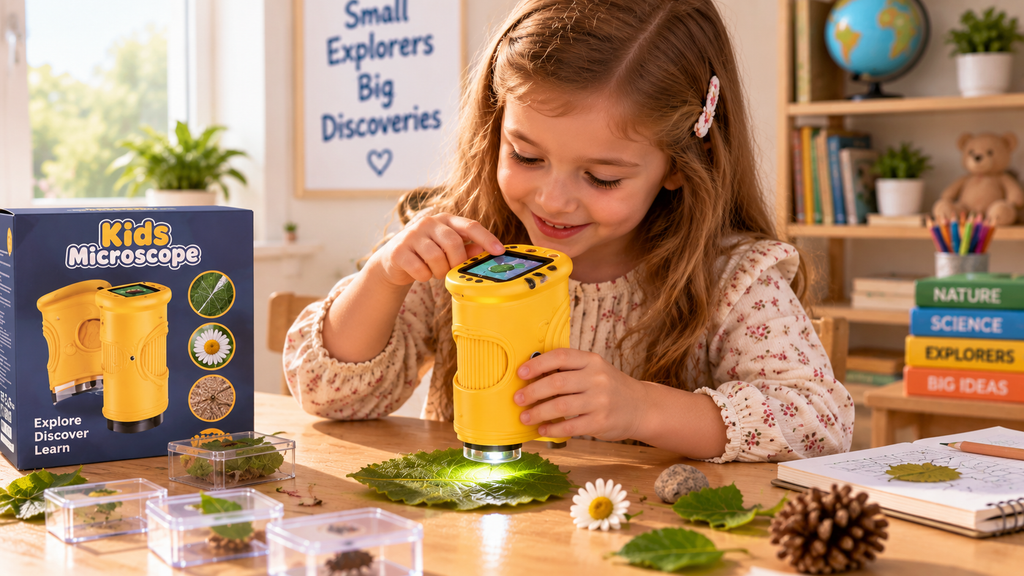
5. Educational Insights GeoSafari Jr. My First Microscope
The Educational Insights GeoSafari Jr. My First Microscope gives young children a chance to look at familiar things in a completely different way. Instead of simply looking at a leaf, rock, feather, or small object, kids can place it under the microscope and investigate details that are difficult to see with the naked eye.
Designed specifically for young children, the microscope has two large eyepieces, a kid-sized focusing knob, and a built-in LED light. Its lower magnification range provides a wider field of view, making it easier for children to understand what they are looking at while learning how a real scientific tool works.
The microscope comes with 12 prepared slides to help children get started, but one of the most interesting parts is being able to explore objects from their own surroundings. A leaf from the backyard, a small rock collected on a walk, a feather, or even a familiar household object can become the subject of a little investigation.
This makes the microscope more than a toy to look through. It encourages children to observe closely, notice differences, ask questions, and describe what they see. Those simple habits are an important foundation for scientific thinking and can turn an ordinary walk or afternoon at home into an opportunity for discovery.
Best for: Observation, nature exploration, early science, and curious kids.
Why it stands out: Instead of giving children information about science, it gives them a tool they can use to investigate the world themselves. The child becomes the observer and gets to decide what to examine next.
Try this: Go outside with your child and collect three safe objects to investigate, such as a leaf, a small rock, and a feather. Before looking through the microscope, ask, “What do you think we’ll see?” Then compare what your child expected with what they actually observe.
Parent tip: The microscope requires 3 AAA batteries, which are not included. Because the kit contains small parts, follow the manufacturer’s safety guidance and supervise younger children during use.

6. Circuits Science Kit
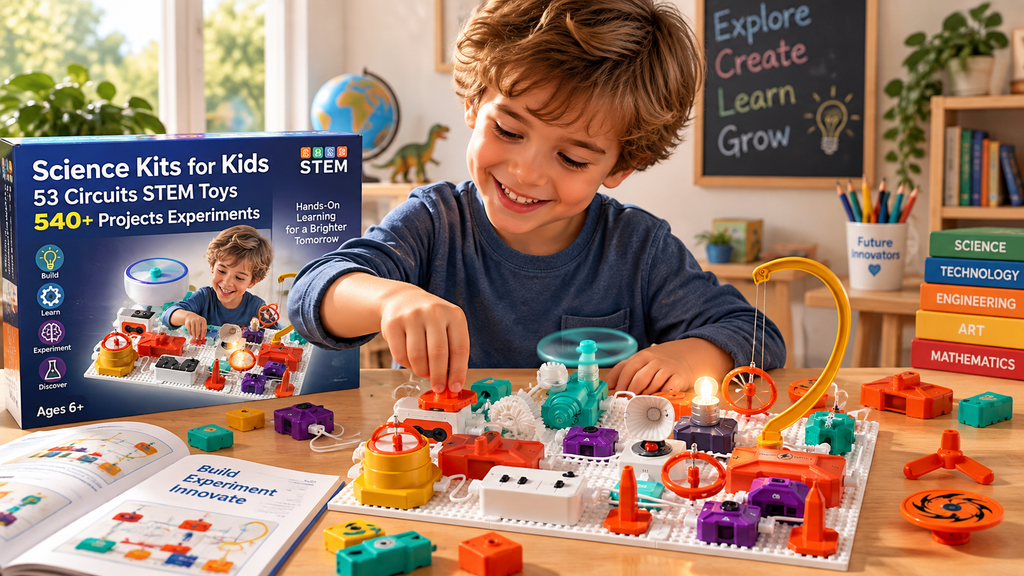
A Circuits Science Kit is a hands-on way for kids to discover how electricity and simple circuits work. Instead of just learning about switches, lights, and electrical connections from a book, children can connect components and see the results of their choices in real time.
The snap-together design makes circuit building approachable for young learners, allowing them to experiment without soldering or complicated tools. Depending on the project, children can create working circuits with lights, switches, fans, and other electronic components while following the included instructions.
One of the most valuable parts of this type of STEM play is what happens when a circuit doesn’t work. A child has to look at the connections, think about what might be wrong, and try a different arrangement. That process introduces an important engineering habit: test, troubleshoot, and try again.
For parents, this can also be a great opportunity to ask questions instead of immediately fixing the problem. Try asking, “Which connection do you think we should check first?” Encouraging children to investigate the problem themselves helps turn a toy into a genuine learning experience.
Best for: Electricity, circuits, logical thinking, troubleshooting, and early engineering.
Why it stands out: Children get to see an abstract concept like electricity produce something they can actually observe. When a light turns on or another component starts working, the connection between their actions and the result becomes much easier to understand.
Try this: Build a simple circuit together and then intentionally change one connection. Ask your child, “What do you think will happen?” Let them test their prediction and figure out why the result changed.
Parent tip: Circuit kits contain small components and may require batteries, so check the manufacturer’s instructions for the specific kit you purchase and supervise younger children during use. Some similar circuit kits are specifically designed for ages 5+ and include additional safety features for younger learners.

7. LeapFrog Magic Adventures Globe
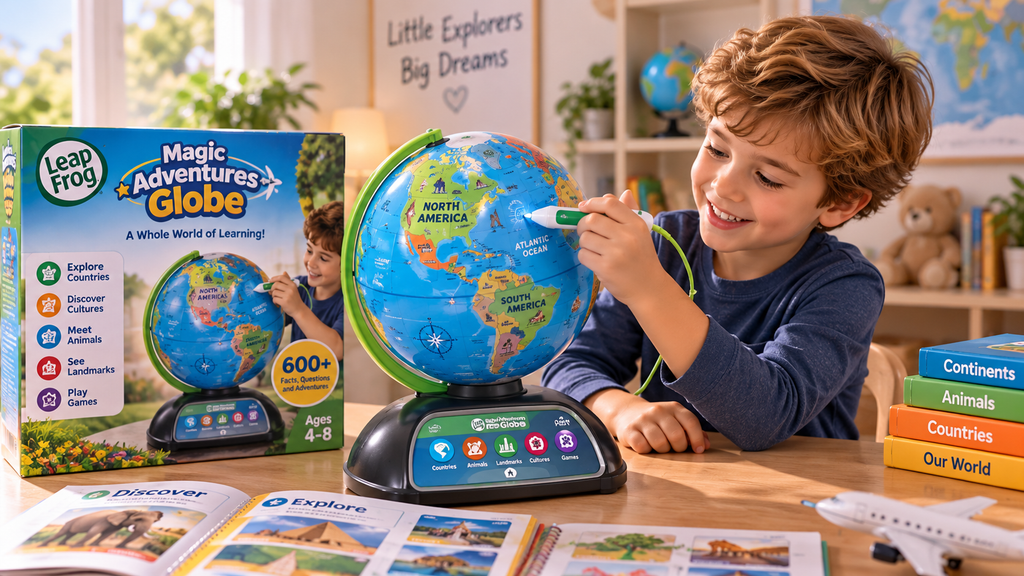
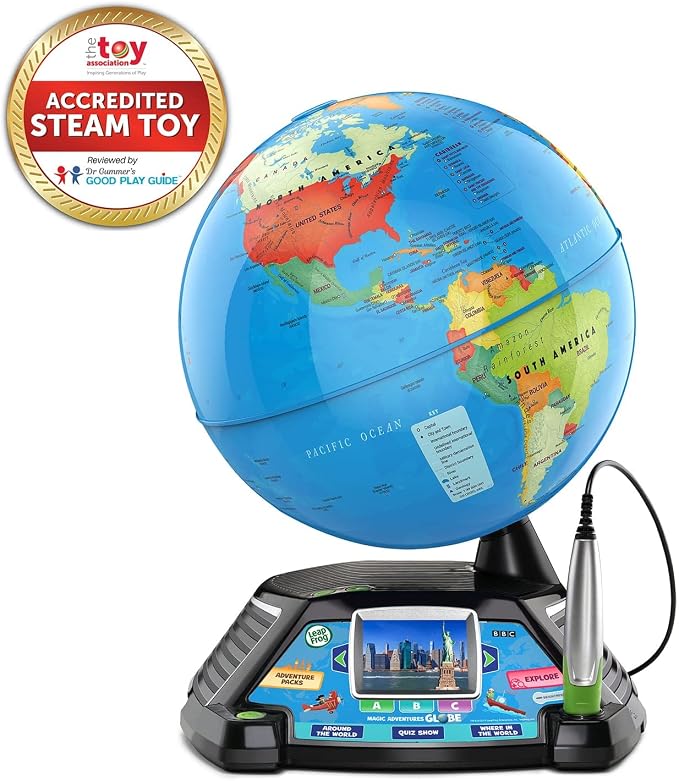
The LeapFrog Magic Adventures Globe turns geography into an interactive exploration rather than a lesson that children simply have to memorize. Using the included stylus, kids can tap different parts of the globe to discover countries, capitals, animals, cultures, languages, landmarks, habitats, and other facts about the world.
One of the most interesting features is the combination of a traditional spinning globe with digital content. A built-in screen shows videos and animations, including BBC content, while the globe itself encourages children to locate places and make connections between what they see on the map and what they learn about each location.
The globe also includes three interactive games. Children can race around the world, test their knowledge with quizzes, or follow clues to solve location-based mysteries. These activities add a problem-solving element to geography and give kids a reason to keep exploring rather than simply looking at the map once.
For curious kids, this can be a great starting point for conversations that go beyond geography. Discovering a country might lead to questions about its animals, language, food, landscapes, or culture. In that way, the globe can turn a simple question like “Where is that?” into a much bigger exploration.
Best for: Geography, world cultures, animals, languages, and curious kids.
Why it stands out: It combines the hands-on experience of exploring a physical globe with videos, facts, and interactive games. Children can discover information by choosing where they want to explore rather than following a fixed lesson.
Try this: Choose a random country with your child and find it on the globe. Then ask three questions: “What animals might live there?” “What language do people speak?” and “What do you think the landscape looks like?” Use the globe to see how many of their guesses they can check.
Parent tip: The globe requires 4 AA batteries. Additional Adventure Packs are available separately and can expand the content with topics such as dinosaurs, food, art and music, mythology, inventions, and pioneers.
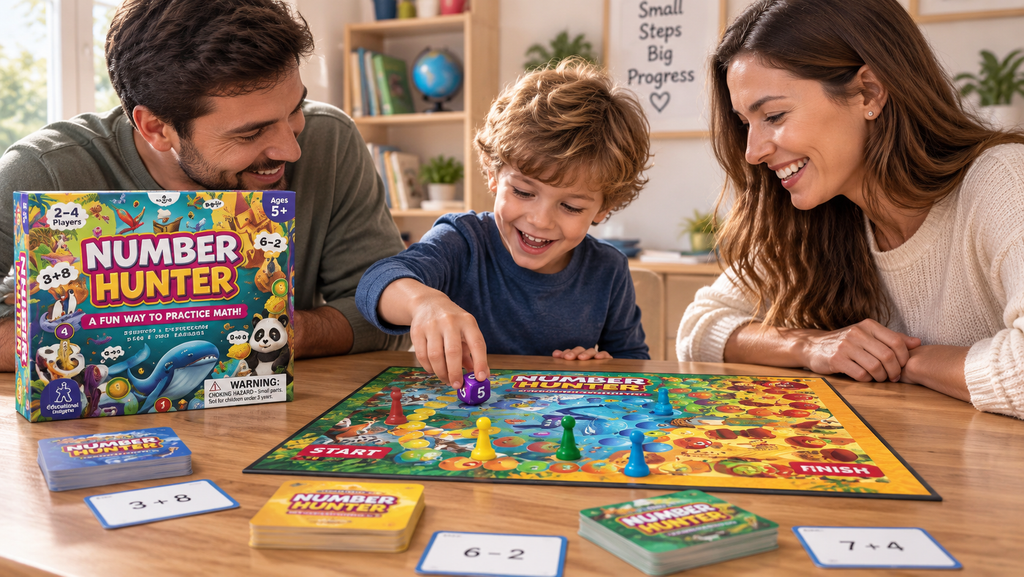
8. Number Hunter Math Board Game for Kids
Number Hunter turns early math practice into a board game adventure. Instead of sitting down with worksheets, children roll the dice, solve simple addition or subtraction problems, and use the answer to move around the board. The goal is to reach the finish line while completing challenges along the way.
The game combines two number dice with an operation die, so children have to decide whether to add or subtract the numbers they roll. Challenge spaces add another layer of play, encouraging kids to think about numbers while also paying attention to what is happening on the board. The game can be played by 2 to 5 players, making it a nice option for siblings, playdates, or family game night.
What makes Number Hunter interesting as a STEM toy is the way it gives children repeated opportunities to practice math without making the activity feel like traditional schoolwork. As they play, they work with numbers, make calculations, follow rules, make decisions, and adjust their strategy as the game progresses.
It’s also a good reminder that math learning doesn’t always have to happen at a desk. A short game can create opportunities to practice addition and subtraction while keeping the emphasis on playing, thinking, and having fun together.
Best for: Early math, addition, subtraction, number recognition, and family game night.
Why it stands out: It turns basic math practice into an interactive race. Children have a reason to calculate the answer because the result directly affects what happens next in the game.
Try this: Before your child rolls the dice, ask, “Do you think you’ll get a bigger number if you add or subtract?” After the roll, let them solve the problem and explain how they reached the answer.
Parent tip: If your child is still learning to read, an adult may need to help with the challenge cards. You can also simplify the game at first by focusing on the basic addition and subtraction mechanic before introducing all of the challenges.

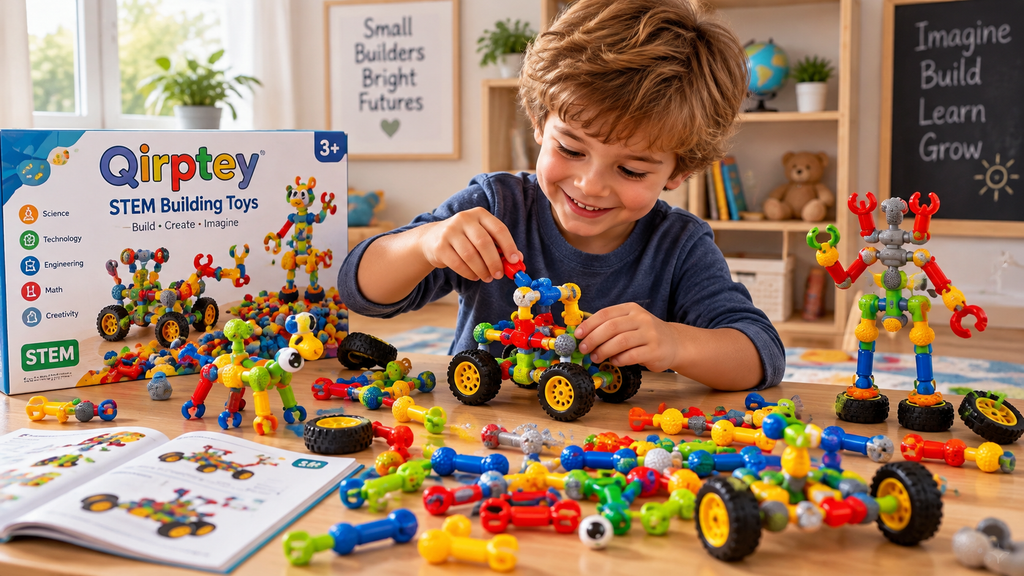
9. Qirptey Kids STEM Building Toys
Qirptey Kids STEM Building Toys give children a hands-on way to explore construction and simple engineering. The set includes colorful pieces in different shapes that can be connected to create models such as race cars, robots, trucks, animals, and other designs. Kids can start by following the included ideas and gradually move toward creating their own structures.
What makes this type of building set especially engaging is the way children have to think about how individual pieces work together. A model needs to be connected securely, and larger or more complex creations need a stable base and balanced structure. If something doesn’t hold together, children can adjust the connections and try again.
The set also encourages children to move beyond simply copying a model. Once they understand how the pieces connect, they can experiment with different shapes, colors, wheels, and structures to create something of their own. That combination of following a plan and then modifying it gives children opportunities to practice fine motor skills, spatial reasoning, creativity, and problem-solving.
For parents, this can be a particularly nice option for children who enjoy making things with their hands. It can also become a collaborative activity, with siblings or parents helping to design a larger creation together.
Best for: Building, fine motor skills, spatial reasoning, creativity, and early engineering.
Why it stands out: The pieces can be used for both guided projects and open-ended building. Children can learn how a model is assembled and then use the same pieces to invent their own designs.
Try this: Ask your child to build a vehicle that can move across the floor. Once it’s finished, challenge them to change the design so it can carry a small toy or object without falling apart.
Parent tip: The set contains small pieces, so follow the manufacturer’s safety guidance and keep individual components away from younger children who may put objects in their mouths. The 125-piece version is listed as suitable for ages 3 and up

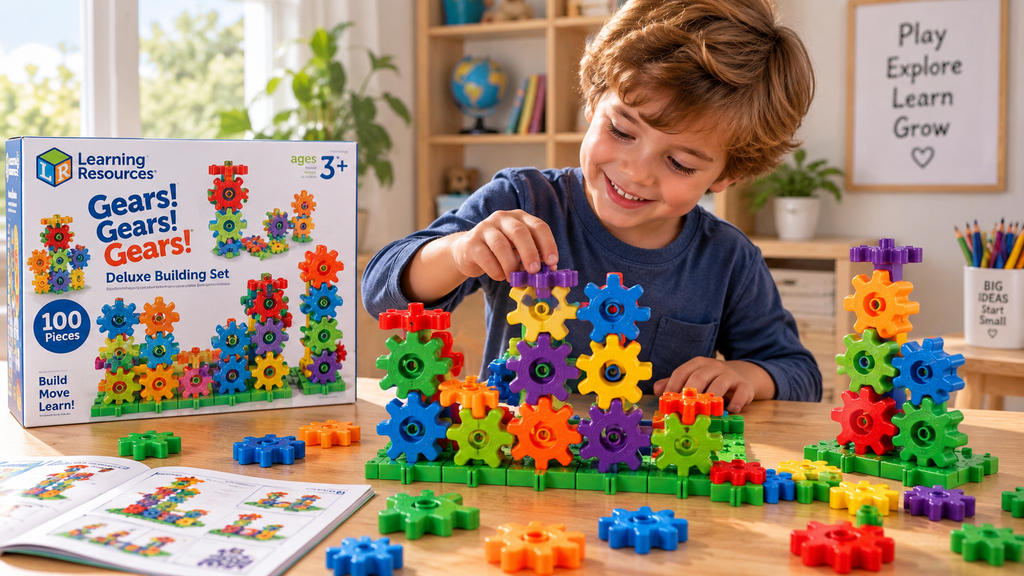
10. Learning Resources Gears Deluxe Building Set
Learning Resources Gears Deluxe Building Set gives kids a chance to build machines that actually move. Instead of creating a structure that simply sits on the table, children connect gears, axles, pillars, and bases to create spinning designs and then use the crank to bring their creations to life.
The 100-piece set includes 46 gears, 26 pillars, 21 six-way axles, six interlocking bases, a crank handle, and an activity guide. The pieces can be arranged in many different ways, allowing children to start with simple constructions and gradually experiment with more complex designs.
What makes this toy particularly interesting for STEM learning is the way it makes cause and effect visible. When one gear turns, it can make another gear move. Children can change the position, size, or arrangement of the gears and immediately see how that affects the motion of the whole structure. This introduces an early understanding of mechanics and engineering through play.
It’s also a toy that encourages trial and error. A gear may not connect correctly, a structure may not move as expected, or the gears may be positioned in a way that prevents the mechanism from working. Instead of simply being a mistake, each problem gives children a reason to investigate, adjust their design, and try again.
Best for: Early engineering, gears and motion, cause and effect, spatial reasoning, and problem-solving.
Why it stands out: Children don’t just build something—they build a mechanism that moves. Seeing their construction come to life makes abstract ideas about motion and mechanical connections much easier to understand.
Try this: Build a simple chain of three or four gears and turn the first one with the crank. Ask your child, “Which direction will the last gear turn?” Then let them test their prediction. After that, challenge them to create a longer gear system and see if they can predict the movement before turning the crank.
Parent tip: The set contains small parts and is recommended by the manufacturer for ages 3 and up. For a 5-year-old, adult participation can make the activity even more interesting, especially when introducing concepts such as gear direction and how one gear transfers motion to another.

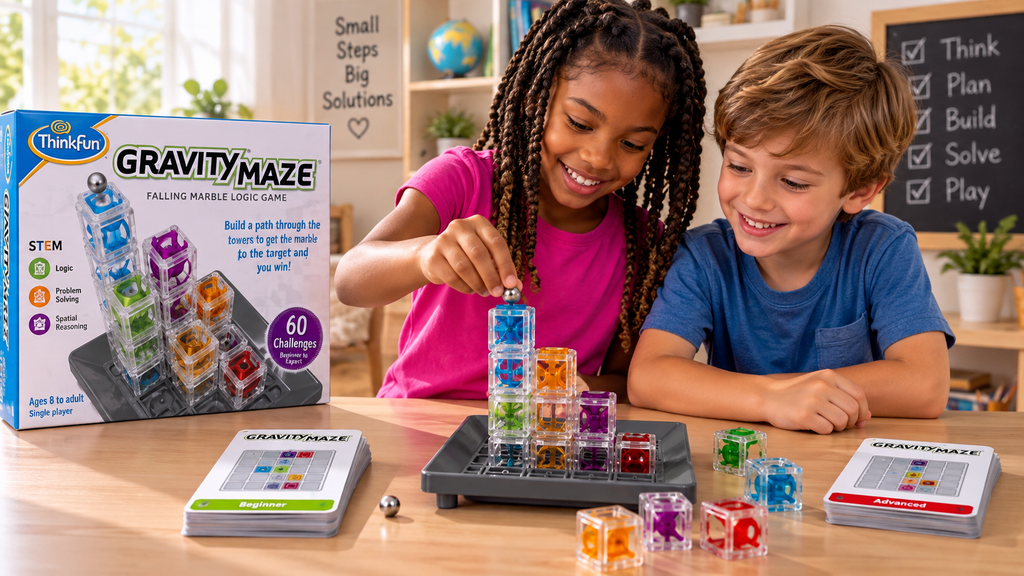
11. ThinkFun Gravity Maze Builder
ThinkFun Gravity Maze Builder combines building and problem-solving in a way that makes kids think about how their choices affect what happens next. Children build marble runs using different pieces and then test their creations to see whether the marble can travel successfully through the path.
What makes this STEM toy particularly interesting is that children aren’t simply following a fixed construction. They have to think about where each piece should go, how the pieces connect, and how gravity will affect the marble’s movement. If the marble stops, falls in the wrong direction, or doesn’t reach the intended destination, kids can change the design and try again.
The building process also introduces early engineering concepts in a very natural way. Children begin to notice that the position and arrangement of each component matters. A small change in one section of the track can completely change what happens at the end, creating an opportunity to explore cause and effect, planning, spatial reasoning, and problem-solving.
Another advantage is that the toy encourages children to learn through trial and error. Instead of being frustrated when their first design doesn’t work, they can investigate what went wrong, make a change, and test the new version. That process helps develop persistence and the idea that problems can often be solved by changing the approach.
Best for: Logic, spatial reasoning, planning, problem-solving, gravity, and early engineering.
Why it stands out: It combines construction with a clear goal: making the marble successfully travel through the path. Children can see the immediate result of their design choices, making concepts such as gravity, movement, and cause and effect easier to understand.
Try this: Ask your child to build a marble path and predict where the marble will go before releasing it. After testing it, ask, “What could we change to make the marble travel farther?” Let your child experiment with different arrangements and compare the results.
Parent tip: This type of toy is most engaging when children are given time to experiment rather than being shown the solution immediately. Ask questions and encourage them to test their own ideas first—especially when a construction doesn’t work the way they expected.

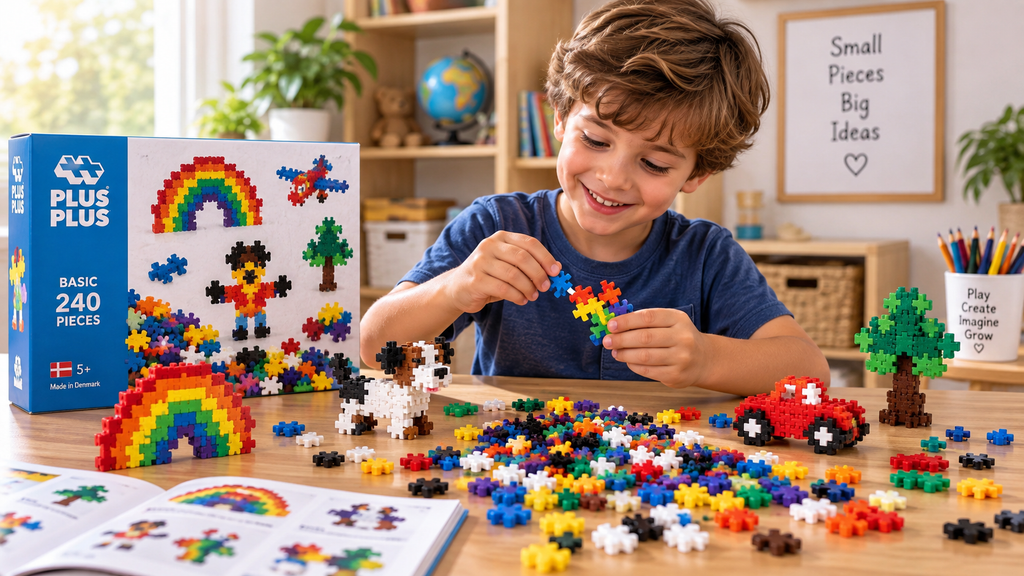
12. Plus-Plus Building Blocks
Plus-Plus Building Blocks offer a different kind of construction play. Instead of using several different brick shapes, children build with one distinctive piece that can be connected in countless ways. The pieces can be used to create both flat 2D designs and more detailed 3D structures, giving kids the freedom to experiment without being limited to a single finished model.
This simple design can actually make the building process more creative. Children have to think about how individual pieces connect and how their arrangement changes the shape of the final creation. They can make animals, vehicles, buildings, patterns, characters, or completely original designs, then take them apart and start again.
Plus-Plus also encourages skills that are valuable in early STEM learning, including fine motor skills, logical thinking, spatial reasoning, focus, patience, and problem-solving. The company specifically positions the toys as supporting STEM learning through hands-on, screen-free construction.
Another nice feature is that Plus-Plus pieces can be used in both guided and open-ended play. Children who prefer instructions can follow building guides, while kids who enjoy inventing their own creations can simply start connecting pieces and see where their ideas take them. The compact pieces also make the toy convenient for travel.
Best for: Creative building, fine motor skills, spatial reasoning, concentration, and problem-solving.
Why it stands out: The one-shape design makes Plus-Plus very different from traditional building bricks. The same type of piece can be combined in countless ways, allowing children to move from simple patterns to much more complex 2D and 3D creations.
Try this: Ask your child to build an animal using only Plus-Plus pieces. Once it’s finished, challenge them to turn the same pieces into something completely different—such as a vehicle or a small building. This encourages them to think about how the same components can be rearranged to create new structures.
Parent tip: The standard Plus-Plus pieces are small and are recommended for children around 5 and up, while the larger Plus-Plus BIG pieces are designed for younger children. Check the specific set before purchasing, especially if you have younger children at home.

13. Osmo Coding Family Bundle – Coding for Kids
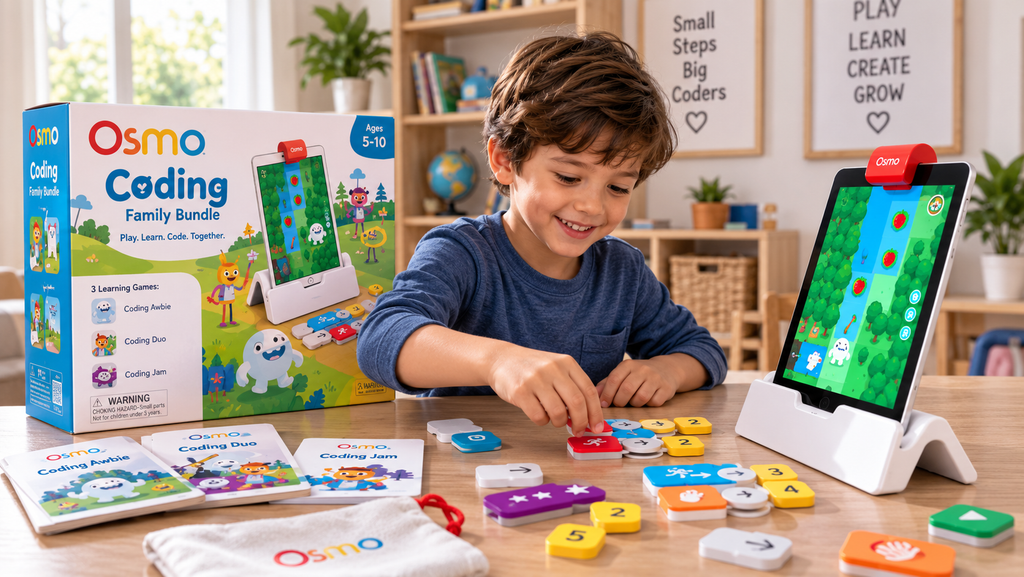
Osmo Coding Family Bundle gives kids a hands-on introduction to coding by combining physical coding blocks with interactive games on a tablet. Instead of typing commands on a screen, children build sequences by connecting colorful blocks and then see their instructions come to life in the game. The bundle is designed for children ages 5–10 and includes three coding games: Coding Awbie, Coding Jam, and Coding Duo.
The physical blocks make abstract coding concepts easier for young children to understand. They can experiment with sequencing, loops, logic, and problem-solving by changing the order or combination of blocks and immediately seeing what happens. This creates a simple connection between the instructions they build with their hands and the result they see on the screen.
Another interesting aspect is that the three games introduce coding in different ways. Coding Awbie focuses on coding fundamentals, while Coding Jam combines coding with music and Coding Duo adds a collaborative element. Together, they give children different ways to practice logical and computational thinking rather than repeating exactly the same type of challenge.
For parents who want to introduce technology without making screen time completely passive, this can be an appealing option. The child isn’t simply watching a game—the physical pieces are part of the interaction, and solving each challenge requires planning, experimentation, and decision-making.
Best for: Coding fundamentals, sequencing, logic, computational thinking, problem-solving, and creative technology play.
Why it stands out: It turns coding into something children can physically build. Instead of starting with complicated programming interfaces, kids manipulate tangible blocks and discover how different instructions change the outcome on the screen.
Try this: Give your child a simple coding challenge and ask them to predict what will happen before they press play. Then change the order of two coding blocks and ask, “What do you think will be different this time?” This encourages children to think about how individual instructions affect the final result.
Parent tip: Check the tablet requirements before purchasing. The current Osmo Coding Family Bundle requires the appropriate Osmo base and compatible device. For iPad, the current system requires iOS 15 or later and does not support iPad generations 1–4, iPad Air 1, or iPad mini 1–3.

14. Botley Coding Robot
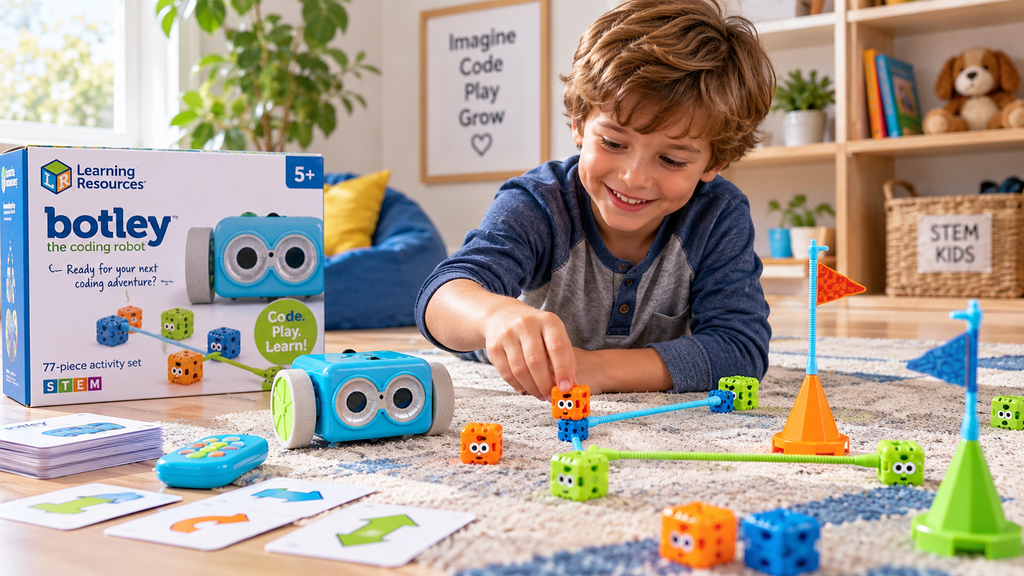
Botley the Coding Robot is a fun way to introduce young children to the basic ideas behind computer programming—without requiring a tablet, phone, or computer. Using the remote programmer, kids can create a sequence of commands and then watch Botley follow their instructions. This makes coding something they can see and control in the real world, rather than something that only happens on a screen.
Children can program Botley to move forward, turn, reverse, detect objects, avoid obstacles, follow black lines, and repeat sequences using loops. The robot can handle sequences of up to 80 steps, giving children room to move from simple commands to more complex challenges as they become comfortable with the basics.
One of the most valuable parts of Botley is what happens when the robot doesn’t do what the child expected. Maybe it turns too early, hits an obstacle, or ends up somewhere completely different. Instead of simply starting over, children can look at the sequence they created, identify the problem, change a command, and test it again. This introduces an important part of real programming: debugging.
Botley also makes coding active. Children can create obstacle courses, plan routes, use coding cards to organize their commands, and experiment with different ways of reaching a destination. This combination of movement, planning, and problem-solving can make the basic concepts of sequencing and logic much easier for young children to understand.
Best for: Coding fundamentals, sequencing, logic, problem-solving, robotics, and screen-free STEM play.
Why it stands out: Botley turns coding into a physical activity. Children write their “program” using commands on the remote and immediately see the robot execute those instructions. The screen-free format is especially useful for introducing programming concepts without adding another digital activity.
Try this: Create a simple obstacle course using books, blocks, or toys. Ask your child to plan a route for Botley from the starting point to the finish without touching any obstacles. Have them arrange their commands before programming the robot, then test the sequence. If Botley takes the wrong path, ask, “Which command do you think we should change?”
Parent tip: Botley requires batteries, which are not included. The standard Botley set contains the robot, remote programmer, detachable robot arms, coding cards, and accessories. The manufacturer recommends it for children ages 5 and up.

15. National Geographic Mega Gemstone Dig Kit
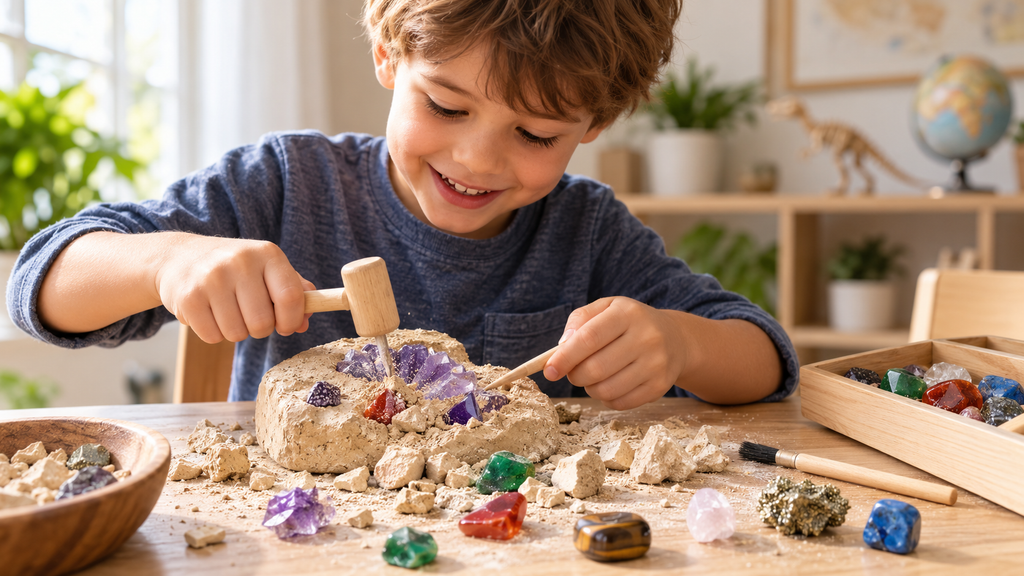
The NATIONAL GEOGRAPHIC Mega Gemstone Dig Kit turns geology into an exciting hands-on discovery activity. Instead of simply looking at pictures of rocks and gemstones, children get to excavate real specimens from a specially designed dig brick, using the included tools to uncover their discoveries piece by piece. The experience combines exploration, observation, and the excitement of not knowing exactly what will appear next.
The kit includes a dig brick, chisel, brush, magnifying glass, and a 16-page full-color learning guide. Children can uncover 15 different gemstones and minerals, including specimens such as pyrite, amethyst, tiger’s eye, fluorite, quartz, obsidian, and aventurine. The guide helps them identify what they find while also introducing how gemstones are formed and mined.
What makes this activity particularly valuable for STEM learning is the process of discovery. Children have to work carefully through the material, observe what they uncover, compare specimens, and use the guide to identify their findings. It’s an opportunity to introduce basic geology while encouraging patience, close observation, and curiosity.
The excavation itself can also become a small scientific investigation. A child might wonder why some stones look different, how crystals form, or where certain minerals come from. Those questions create natural opportunities for parents to explore geology together rather than simply giving children the answers.
Best for: Geology, nature exploration, observation, hands-on science, and curious kids.
Why it stands out: The learning happens through discovery. Children aren’t just being told about gemstones—they physically uncover real specimens and then investigate what they found. That combination of excavation, observation, and identification makes the experience feel like a genuine little scientific expedition.
Try this: Before your child starts digging, ask them to predict what they might find and which gemstone they think will be the most interesting. After each discovery, use the guide to identify it and ask, “What do you notice about this one compared with the others?” You can even create a simple collection chart showing each specimen they uncover.
Parent tip: The excavation involves a chisel and a dig brick, so adult supervision is recommended. It can also get messy, making a tray or outdoor workspace a good idea. And because the exact Mega Gemstone Dig Kit has been listed with different age guidance across retailers, check the age recommendation on the specific Amazon listing before purchasing.

How to Choose the Best STEM Toy for Your 5- Year-Old
The best STEM toy isn’t necessarily the most expensive or the most technologically advanced one.
Instead, think about how your child naturally likes to play.
If your child loves building
Consider construction toys such as LEGO, magnetic tiles, gears, or Plus-Plus.
These toys encourage children to create structures while developing spatial reasoning and problem-solving skills.
If your child loves science
Science experiment kits, magnet sets, microscopes, and gemstone excavation kits can be great choices.
They allow children to investigate the world through observation and experimentation.
If your child loves numbers
A math-focused board game can make early numeracy practice more enjoyable and interactive.
If your child is fascinated by technology
Coding toys such as Osmo or Botley can introduce programming concepts without requiring children to sit through traditional lessons.
If your child constantly asks “why?”
Look for toys that encourage experimentation.
A toy that allows a child to make a prediction, test it, see what happens, and try again can provide a much richer learning experience than a toy with only one predetermined outcome.
Do STEM Toys Really Help Kids Learn?
They can — especially when children are actively involved in the process.
The value of a STEM toy isn’t simply that it has the word “educational” on the box.
What matters is what the child actually does with it.
Building a structure requires planning. Solving a puzzle requires logical thinking. Experimenting with magnets involves observation and prediction. Coding a robot requires sequencing and problem-solving.
These experiences can turn ordinary play into opportunities to develop important skills.
And perhaps most importantly, children can learn that making a mistake is part of figuring something out.
Are STEM Toys Good for 5-Year-Olds?
Yes, STEM toys can be a great fit for five-year-olds because children at this age are developing increasingly sophisticated problem-solving, reasoning, language, and motor skills.
However, the best choice depends on the individual child.
Some children will spend hours building with LEGO. Others may be fascinated by insects, rocks, or science experiments. Some will immediately become interested in coding, while others will prefer puzzles or math games.
The goal isn’t to make every child interested in every area of STEM.
It’s to find something that connects with what your child is already curious about.
Final Thoughts
The best STEM toys for 5-year-olds are the ones that make children want to keep exploring.
From classic construction toys like LEGO and magnetic tiles to science kits, microscopes, coding robots, math games, and geology activities, there are many ways to introduce STEM concepts through play.
When choosing a toy, consider your child’s interests first.
A curious child who loves building may get the most from a construction set. A child fascinated by nature may prefer a microscope or gemstone kit. And a child who loves technology may enjoy experimenting with coding.
Ultimately, the best STEM toy isn’t the one that looks the most educational.
It’s the one that makes your child curious enough to ask, “What happens if I try this?”