
Reading Aloud to Kids of Different Ages: Making Room for Both
At bedtime in our home, my six-year-old son Noah and my three-year-old daughter Liz each choose a book. I choose one too. On a good night, that means three stories. On another night, someone falls asleep halfway through, the children would rather move than listen, or we simply run out of time. I still want books to belong to our evenings, but I have stopped treating three finished stories as proof that the night went well.
Reading with two children at different stages presents a small, familiar puzzle. The older child may want a longer plot and more questions. The younger child may want to name what she sees, turn pages quickly, or hear a favorite book yet again. How do you give both a voice without making one child wait through a reading session that feels designed for the other?
I do not think the answer is finding a book that perfectly matches everyone, every night. It is building a flexible invitation: there is room for your choice, your way of listening, and your conversation here.
Letting each child choose changes the feeling of the routine
When my children pick their own books, they do not always pick the ones I would have chosen. A tractor story may win over the book with the meaningful lesson. The same title may come back for days. But their choices tell me something about what interests them right now, and they know I am willing to listen.
Choice also helps when siblings are at different ages. The preschooler does not need to graduate prematurely to her brother’s longer story, and the older child does not have to abandon a book because it looks too young. A child can love a familiar picture book long after they are able to follow a more complex one.
The American Academy of Pediatrics encourages parents to keep reading aloud even after children can read independently, to follow their interests, and to let them choose books—even when that means a repeat. Reading together is not only preparation for school. It can remain something a school-age child shares with you.
One story can hold two kinds of attention
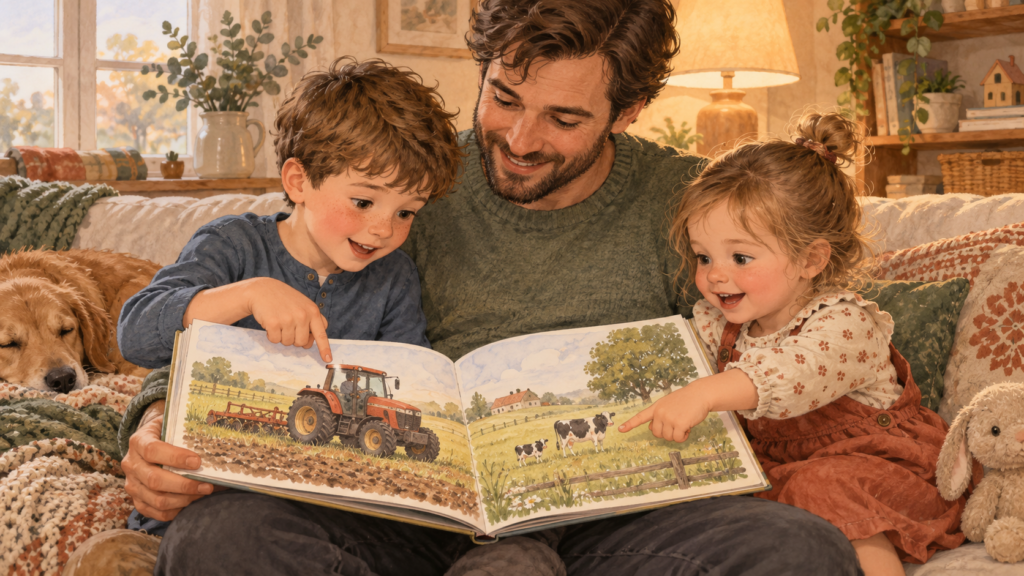
Reading the younger child’s picture book does not mean the older child has nothing to do. In a single illustration, Liz may point to a cow while Noah notices what has changed since the previous page. One child might supply a repeated phrase; the other might predict what a character will do. Neither response needs to become a test.
The same applies in the other direction. When the older child chooses a story with more words, the younger one can listen for a moment, study the pictures, sit close, or wander a little and return. A three-year-old’s movement does not necessarily mean she has gained nothing from being nearby. As NAEYC explains, young children can participate in read-alouds through pointing, gestures, words, questions, and even some movement; finishing the book is not the only measure of a worthwhile exchange.
What helps me is asking a different kind of question of each child, when the moment invites it. Instead of “What color is this?” for everyone, I might name a detail with the younger child and ask the older one, “What do you think will happen next?” Sometimes no question is needed. We can just enjoy the story.
Let the older child have an older-child moment
Fairness does not always mean identical attention. If Noah wants a longer book, we can read a few pages after Liz has had her turn or after she has settled beside us. If the evening is too short, that book can wait for another moment—perhaps a few minutes during the day. This is an option, not a second daily assignment for an already tired parent.
It can also help to let the older child participate without making him responsible for entertaining the younger one. He may want to read a sentence, turn a page, or explain a favorite illustration. He may also want to be the child who is read to. A child learning to read still deserves the pleasure of listening without being asked to perform.
For more on protecting that pleasure as children grow, see How to Raise a Reader Without Turning Books Into Homework.
Some nights, the routine is smaller
I know the appealing picture: everyone tucked in, three books read from beginning to end, and a peaceful conversation afterward. Our real evenings also include resistance, tiredness, and children who fall asleep in the car. Sometimes we read one book. Sometimes none. We return to it when we can.
If the original plan is not working, a smaller version can preserve the connection:
- Read just a few pages and stop where interest ends.
- Look at one illustration and let each child tell you what they notice.
- Invite each child to pick a book, then save one for tomorrow.
- Read earlier in the day if bedtime has become too crowded.
- Let another caregiver take a turn, or let an older child listen while you read to the younger one.
These are possibilities, not a new checklist. The AAP’s advice that a story does not have to be finished when a child loses interest is a helpful reminder: reading aloud is a relationship, not a completion task.
Keep the conversation open, not quizzed
I choose a book too, sometimes because it introduces an idea I would like to share. But I do not need to turn every tractor story into a lesson. Some nights, listening to what the children choose is the whole point. If a question naturally comes up, we talk. If it does not, we close the book.
That kind of back-and-forth matters. The Harvard Center on the Developing Child describes how responsive exchanges—notice what a child is interested in, respond, and allow them to respond back—support early development. In a reading routine, that can look as ordinary as pausing because a child wants to point at a picture.
What I hope they remember
I cannot guarantee that both children will enjoy the same book at the same time. I can make a little room for each child’s voice. Noah and Liz may not remember which nights we finished all three stories. I hope they remember that books were something we shared, that their choices counted, and that an imperfect evening did not end the invitation to try again tomorrow.
References and further reading
- American Academy of Pediatrics: Tips to Help Your Child Enjoy Reading Aloud
- NAEYC: Reading Aloud with Infants and Toddlers
- Harvard Center on the Developing Child: Serve and Return
The family examples are Lucy’s personal experience. The illustrations are artistic representations, not photographs of her family.