A Playroom Is Not a Store: How to Create a Space That Encourages Real Play
A playroom can be one of the most hopeful spaces in a home.
It is where parents imagine children building, reading, pretending, drawing, relaxing, and spending long stretches of time happily absorbed in their own ideas.
But many playrooms become something else.
They become storage rooms for toys. They become the place where every birthday gift, hand-me-down, craft supply, puzzle piece, and stuffed animal eventually lands. They become crowded, loud, difficult to clean, and surprisingly hard for children to use independently.
The problem is not that families own too many things or that parents care too much about making childhood fun.
The problem is that a playroom is often designed to hold toys rather than support play.
Those are not the same thing.
A Good Playroom Does Not Need to Impress Anyone
It is easy to compare a family home to a beautifully styled playroom online.
There may be matching baskets, a climbing wall, a reading nook, custom shelving, neutral toys, themed décor, and carefully arranged materials. These spaces can be inspiring, but they can also create pressure.
A child does not need a photogenic playroom in order to play well.
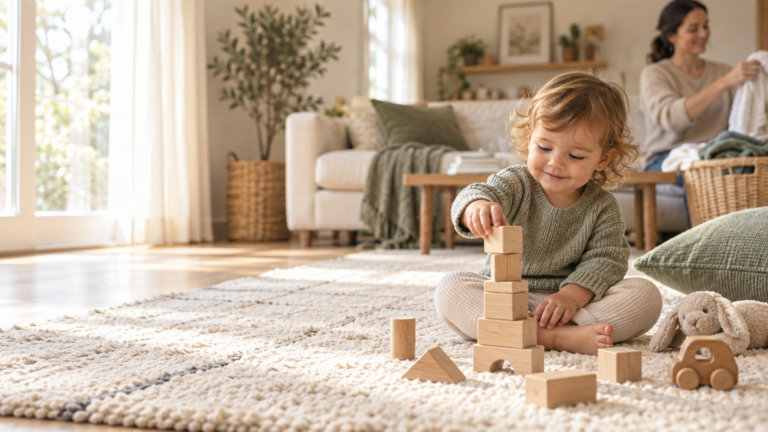
They need a space where they can see what is available, reach what they are allowed to use, make choices without asking an adult every few minutes, and stay with an idea long enough for it to become interesting.
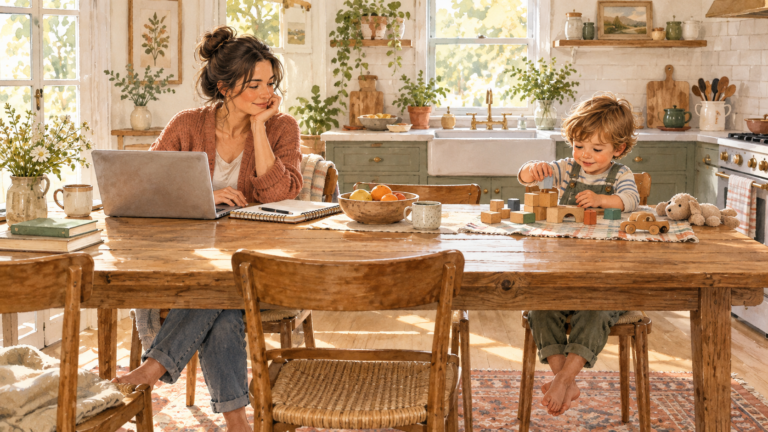
That may happen in a dedicated playroom. It may also happen in a corner of the living room, under the stairs, in a bedroom, or at the kitchen table.
The goal is not a perfect room. The goal is a space that works for the children who live in it.
More Toys Do Not Automatically Create Better Play
A common instinct is to solve boredom by adding something new.
Another toy. Another set. Another activity. Another bin.
But more choices do not always make play easier.
A small 2018 study by Carly Dauch, Michelle Imwalle, Brooke Ocasio, and Alexia Metz compared toddlers’ play in settings with four toys and sixteen toys. In the smaller-toy setting, children spent longer playing with individual toys and used those toys in a greater variety of ways.
The study was small and took place in a controlled setting, so it should not be treated as a strict rule for every family. But it supports an idea many parents recognize at home: when fewer things compete for a child’s attention, it can be easier for them to settle into play.
This does not mean children should own only four toys.
It means a playroom does not need to display everything at once.
A Playroom Should Make Choices Easier
Imagine entering a room where every shelf is full, every basket is overflowing, and every surface has something on it.
Adults can feel overwhelmed in spaces like that. Children can too.
When everything is visible and available at the same time, children may move rapidly from one item to another. They may dump out baskets without knowing what they are looking for. They may ask for help not because they cannot play, but because there is simply too much to process.
A calmer playroom often gives children fewer, clearer choices.
That might look like:
- Blocks on one accessible shelf
- Books in one basket or low bookcase
- A small set of animals or dolls
- Basic art supplies within reach
- A clear floor area for building or pretending
- A place for unfinished creations to stay for a while
The materials do not need to match. The containers do not need to be expensive. What matters is that children can understand the space.
The Best Toys Usually Have More Than One Use
Some toys tell children exactly what to do. Others leave room for interpretation.
A toy with one clear function is not bad. Puzzles, games, dolls, vehicles, and building sets can all be wonderful. But a playroom becomes more flexible when at least some materials can change depending on the child’s idea.
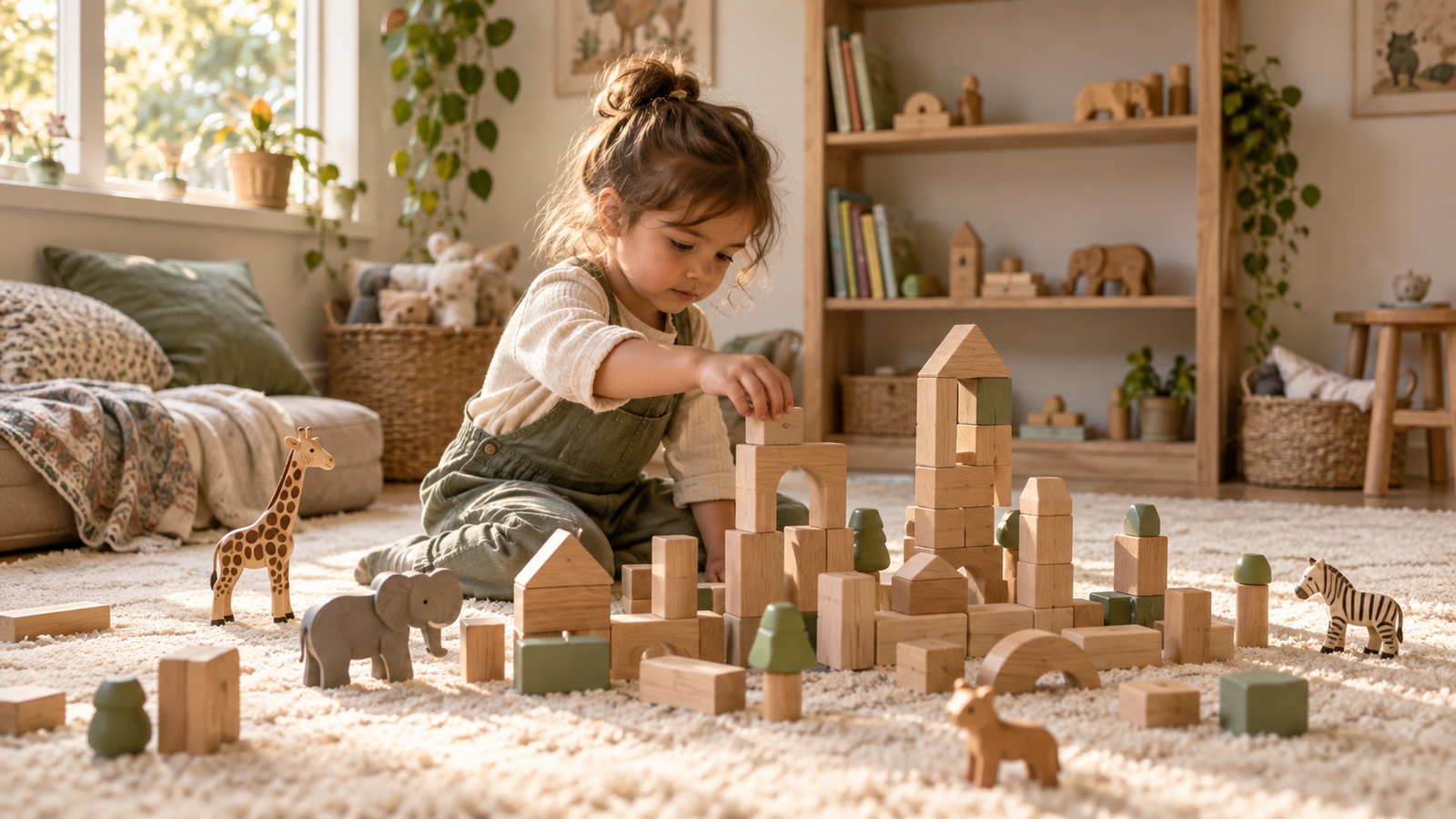
Blocks can become a road, a castle, a shop, a zoo, or a family home.
Scarves can become costumes, blankets, rivers, picnic cloths, or superhero capes.
Toy animals can become a veterinary clinic, a jungle, a classroom, or a rescue mission.
Cardboard boxes can become almost anything.
Open-ended materials give children a starting point without deciding the whole story for them.
The American Academy of Pediatrics has described play as an important way children develop social-emotional, language, cognitive, and self-regulation skills. That does not require a complicated setup. It often begins with ordinary materials and enough freedom to experiment.
A Playroom Needs Space for the Child’s Ideas, Not Just the Parent’s System
Organization helps, but overly rigid organization can create a room that is easy to photograph and difficult to enjoy.
Children may not sort toys the way adults do. They may combine animals with blocks, scarves with toy cars, and dolls with cardboard boxes. That is not always messiness for its own sake. It can be a sign that they are building a more complex story.
A useful system gives children enough structure to find and return materials, while leaving room for them to mix, invent, and change things.
Instead of expecting every toy to return to a perfectly labeled bin immediately, try creating a simple reset routine:
- Put away one category before dinner.
- Keep one basket for toys that need adult help to sort.
- Let a larger project stay out overnight if a child is still using it.
- Ask children to choose which toys should remain accessible.
- Revisit the system when it stops working.
A playroom should serve the family’s real life. If the system creates more arguments than it solves, it needs adjusting.
Rotation Is Not About Deprivation
Toy rotation can sound intimidating, as if parents need to carefully schedule every item their child owns.
It does not have to work that way.
At its simplest, rotation means keeping some toys out of sight for a while and bringing them back later. This can make the room feel less crowded and allow familiar toys to feel fresh again.
You might keep out:
- One building option
- One pretend-play option
- One creative option
- A small group of books
- A few comfort items or favorite toys
The rest can live in a closet, cabinet, storage box, or another room.
There is no need to rotate every week. There is no need to follow a strict formula. The point is to notice what children are actually using and make the room easier for them to navigate.
The Playroom Does Not Need to Keep Children Busy Alone All Day
Independent play is valuable, but a playroom is not meant to replace connection.
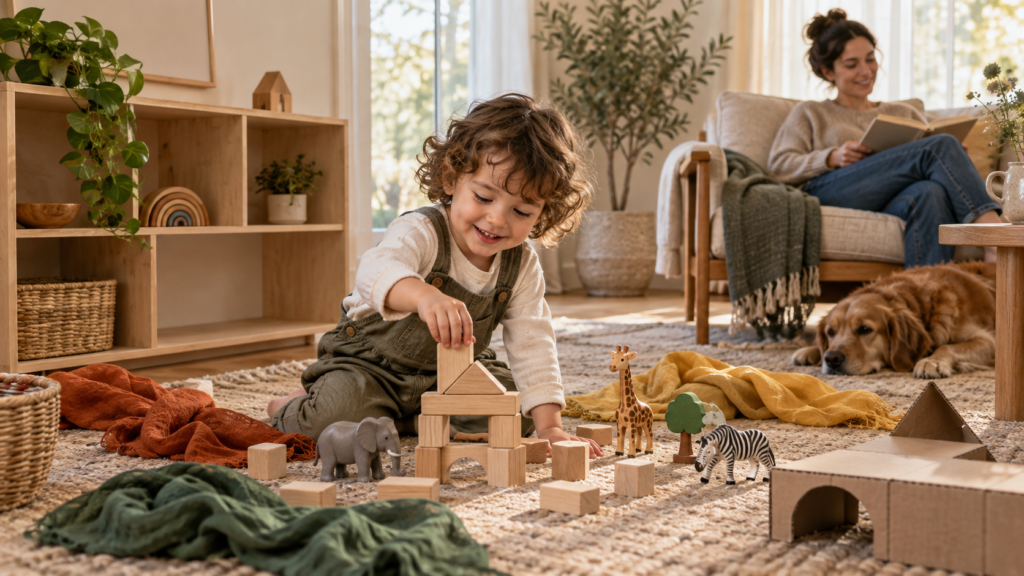
Children often play more deeply when they know an adult is nearby, even if that adult is cooking dinner, answering emails, folding clothes, or simply sitting with a cup of coffee.
Sometimes a child will invite a parent into the game. Sometimes they only need a few minutes of help getting started.
A parent might say:
- “I can help you choose one thing to begin with.”
- “Tell me what you are building.”
- “Would you like me to be the customer for two minutes?”
- “I am going to finish this task, and you can keep working on your zoo.”
That kind of response supports both connection and independence.
The goal is not to entertain children constantly. It is to create an environment where they feel safe enough to follow their own ideas.
What a Functional Playroom Can Look Like
A functional playroom may have visible signs of actual childhood.
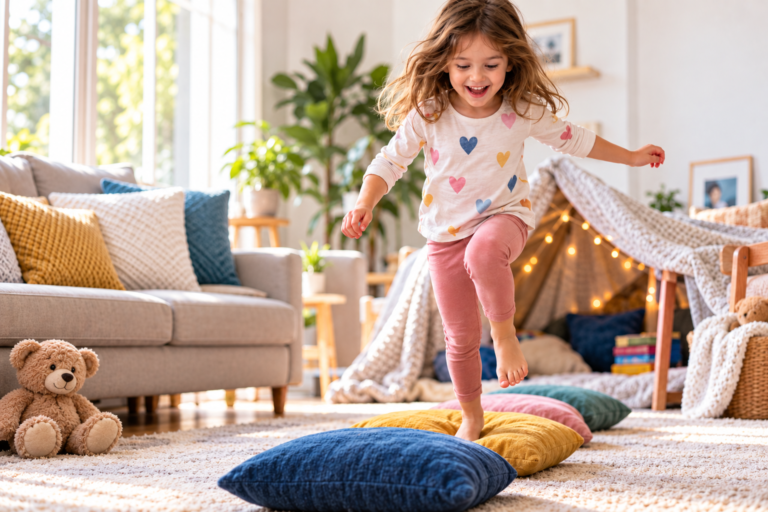
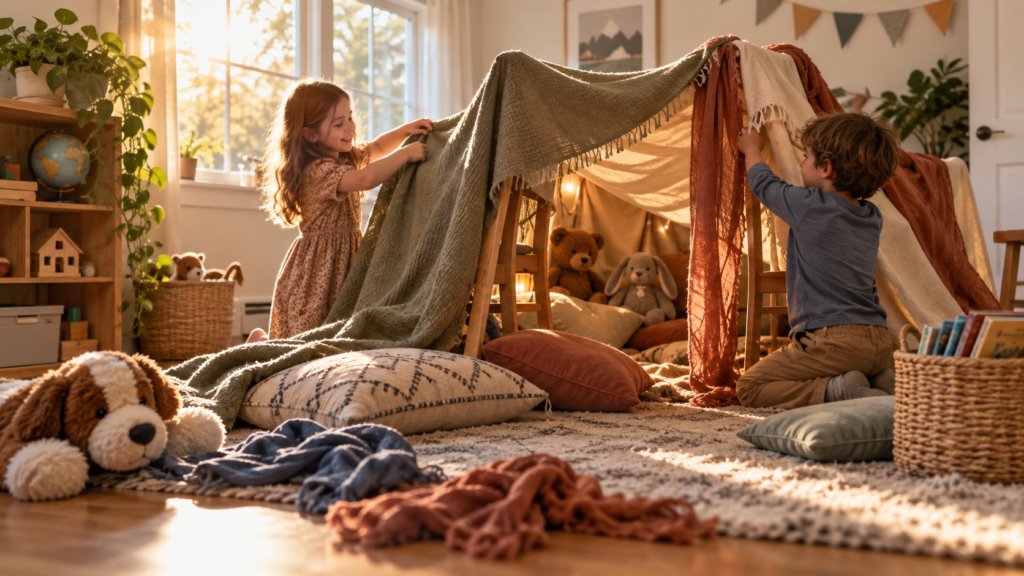
It may have a half-finished block tower. It may have books that are not perfectly aligned. It may have a blanket fort that stays up for two days. It may have crayons in the wrong bin and toy animals under the couch.
That does not mean the room has failed.
A playroom is working when children return to it, use it, change it, and make it their own.
The room does not need to look empty. It does not need to look curated. It needs to make play feel possible.
A Calm Reset for an Overwhelming Playroom
If the room feels too full, start gently.
Do not try to organize every toy in one exhausting afternoon. Begin by taking out obvious broken items, duplicates, toys that no longer fit your child’s age, and things that have not been touched in months.
Then choose a small number of categories to leave available.
Watch what happens over the next week.
Which materials do children return to? Which toys create arguments? Which items are too difficult to put away? Which toys invite longer play? Which objects only create clutter?
Your children’s behavior will tell you more about the room than a perfect organizing system ever could.
The Case for “Less” Is Not About Perfection
The idea of simplifying a playroom is sometimes misunderstood as another way for parents to be judged.
It is not about owning fewer things to prove something. It is not about minimalism as an aesthetic. It is not about removing every bright toy, plastic item, or beloved stuffed animal.
It is about reducing friction.
Kim John Payne’s book Simplicity Parenting explores the broader idea that modern family life can become overloaded with too many choices, commitments, and possessions. You do not need to follow every part of that approach to see the value in one simple question:
Does this room make it easier or harder for my child to play?
That question is more useful than asking whether the room looks finished.
Final Thoughts
A playroom is not a store display. It is not a storage solution. It is not a measure of how creative, organized, or devoted a parent is.
It is simply a place where children should be able to play.
When there is less visual noise, clearer access to materials, room for movement, and permission for imperfect projects, children often have more space to do what play is meant to allow: imagine, experiment, repeat, create, and connect.
A good playroom does not need more things.
It needs more possibility.
Sources and Further Reading
- Dauch, Imwalle, Ocasio & Metz: The Influence of the Number of Toys in the Environment on Toddlers’ Play
- American Academy of Pediatrics: The Power of Play
- Payne, Kim John, with Lisa M. Ross. Simplicity Parenting: Using the Extraordinary Power of Less to Raise Calmer, Happier, and More Secure Kids.